
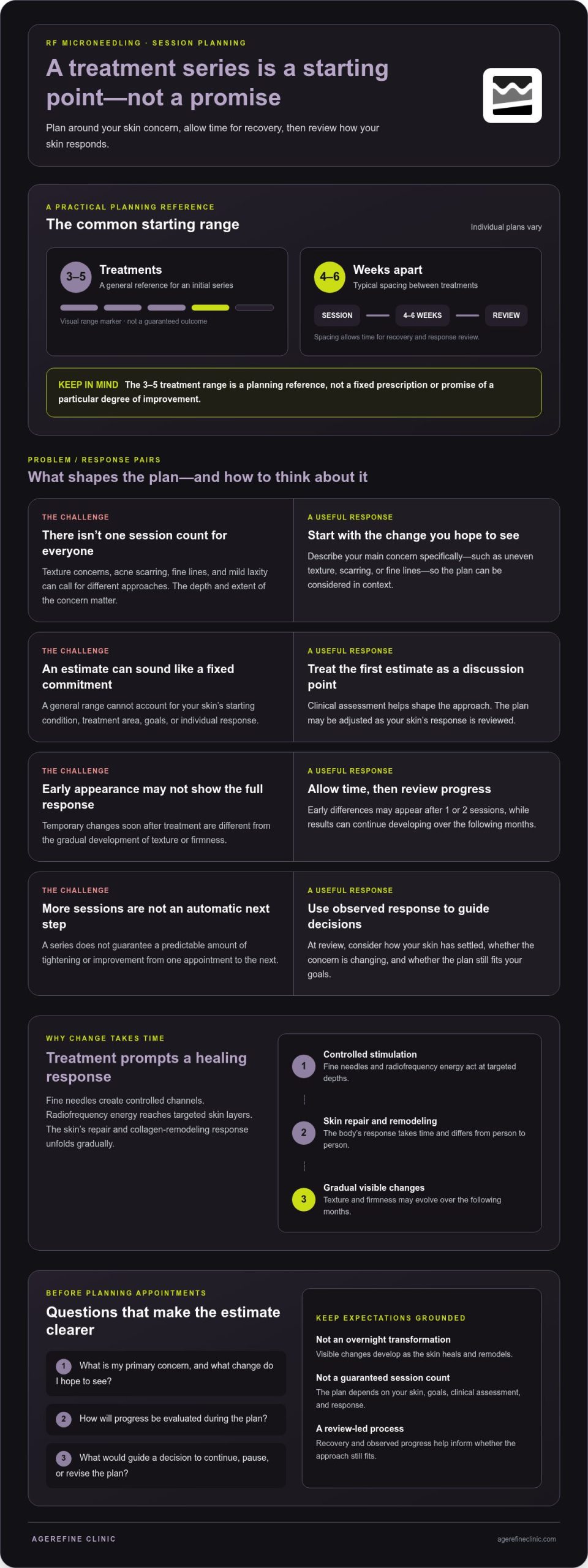
Could one RF microneedling appointment be enough to make a visible difference? It’s understandable to want a clear number before you begin, especially when treatment plans vary by skin concern. If you’re wondering how many RF microneedling sessions are needed, a common starting plan is 3 to 5 treatments, typically spaced 4 to 6 weeks apart. Use that range as a planning reference, not a promise or fixed prescription.
The right number depends on your goals and how your skin responds. Fine lines or mild laxity may call for a different plan than more pronounced acne scarring. The treatment area, your skin’s condition, and the device protocol also matter. Because collagen remodeling takes time, changes are gradual: early differences may appear after 1 or 2 sessions, with results continuing to develop over the following months.
This guide covers typical session planning, factors that can affect your timeline, and how to think about spacing, recovery, and results without expecting an overnight transformation. At AgeRefine Clinic in Irvine, an individualized assessment helps shape RF microneedling plans for skin texture. Led by Helen Liu, a board-certified nurse practitioner specializing in aesthetic medicine, the clinic serves patients across Orange County.
Key Takeaways
- There’s no single answer to how many RF microneedling sessions are needed. A personalized plan starts with your skin goals and clinical assessment.
- RF microneedling uses fine needles and radiofrequency energy. Visible changes develop as the skin heals and remodels.
- Texture concerns, acne scarring, fine lines, and mild laxity may call for different approaches based on their depth, extent, and your goals.
- Allowing time for recovery and reviewing your skin’s response helps guide whether to continue or adjust the plan.
- At AgeRefine Clinic, individualized planning connects your skin concern with realistic expectations and progress review points.
How Many RF Microneedling Sessions Are Needed? Start With a Realistic Range
RF microneedling is commonly planned as a series rather than a single appointment. As a general reference, an initial series may include 3 to 5 treatments. This range gives you a sense of what a plan might involve, but it isn’t a universal prescription. The appropriate number depends on your skin, your goals, and the clinician’s assessment.
RF microneedling combines fine needles with radiofrequency energy. The treatment area and the concern you want to address help shape the plan, including the number of sessions. No session count can guarantee a particular degree of improvement, and one appointment shouldn’t be expected to produce the same changes as a full series.
Why there is no single session count for everyone
Planning starts with the change you hope to see. Someone focused on overall texture may have different needs from someone addressing visible scarring or fine lines. Your skin’s starting condition and the extent of the concern matter, too. These factors shape the treatment approach, which is why a general estimate can’t account for every person.
An early estimate is a starting point for discussion, not a final recommendation. A clinician can assess your skin, tailor a plan, and consider your response as treatment progresses. Because people respond differently, the number of sessions may be adjusted instead of treated as a fixed commitment.
What to clarify before starting a treatment series
Before planning appointments, identify your main concern and describe what you hope will look different. “Improved texture” can mean different things, so be specific about whether you’re focused on unevenness, scarring, or fine lines. Clear goals make it easier to discuss a realistic approach.
Ask how progress will be reviewed and what would guide a decision to continue, pause, or revise the plan. It’s also useful to understand how the proposed session count relates to your skin assessment, rather than relying on a number you saw elsewhere. These conversations help set expectations without turning a typical range into a promise.
Session estimates are individualized because skin concerns, starting conditions, and treatment goals differ.
- Describe your primary concern and the change you hope to see.
- Discuss how your clinician will evaluate progress during the treatment plan.
- Treat the 3 to 5 session range as a general reference, not a guarantee.
A thoughtful plan leaves room for review. At AgeRefine Clinic, RF microneedling for skin texture is planned through individualized assessment, with your concern and clinical evaluation guiding the approach.
Why RF Microneedling Results Develop Gradually Across Sessions
RF microneedling prompts a response from the skin rather than creating an instant change in texture or firmness. Fine needles create controlled channels, while radiofrequency energy reaches targeted skin layers. The treatment is designed to stimulate a healing process, not to replace or erase skin tissue.
How controlled stimulation supports skin remodeling
The needle channels provide controlled stimulation. Radiofrequency adds thermal energy at targeted depths, alongside the mechanical action of the needles. The skin responds with a repair process that can involve collagen remodeling. Collagen is a structural protein that helps support the skin, but the body’s response takes time and varies from person to person.
Visible outcomes may take time because the treatment first stimulates a healing response, and any resulting collagen remodeling unfolds gradually rather than immediately after the appointment.
This process helps explain why clinicians may recommend a series when appropriate. It doesn’t mean that each session produces a predictable amount of tightening or improvement. The degree of change varies, and RF microneedling can’t guarantee a particular outcome.
Why one appointment may not show the full outcome
What you notice shortly after treatment may not reflect the skin’s eventual response. Temporary post-treatment changes and the gradual development of texture or firmness are different parts of the timeline. Avoid judging the overall outcome only by the first few days or a single early observation.
A clinician may recommend additional sessions when they’re appropriate for your skin and goals. Each appointment should be considered in light of your response to earlier treatment, not as an automatic step toward a promised result. That’s why the answer to how many RF microneedling sessions are needed depends on progress review.
Review timing should account for both recovery and the slower tissue response. At follow-up, the treating clinician can consider how your skin has settled, whether the concern is changing, and whether the plan still fits your goals. Visible progress and its timing differ between individuals; an assessment helps interpret what you’re seeing and guide next steps.
- Short-term changes: The skin’s immediate appearance after treatment isn’t the same as its later response.
- Gradual changes: Texture and firmness may evolve as the skin’s repair and remodeling processes progress.
- Plan adjustments: Further sessions should depend on clinical appropriateness and observed response, not an assumed fixed result.
Patience is part of realistic planning. If you’re considering RF microneedling for skin texture, a personalized assessment can help set expectations and establish how your progress will be reviewed.
How Session Needs Can Differ by Skin Concern
The same treatment may be planned differently depending on what you want to address. A broad goal such as smoother-looking texture isn’t the same as treating distinct acne scars or seeking a change in mild laxity. The concern’s depth and extent, your skin’s condition, and the degree of change you hope to see all inform the plan. That’s why how many RF microneedling sessions are needed can’t be determined by the concern’s name alone.
Concern: Overall texture or visible pores
Planning considerations: The area involved, the pattern of unevenness, and your specific texture goals.
Reassessment: Review whether the treated area’s appearance is changing in a way that aligns with your goals. RF microneedling shouldn’t be described as permanently closing pores.
Concern: Acne scarring
Planning considerations: Scar type, depth, distribution, and severity. Scattered shallow marks may call for a different approach than deeper or more localized scars.
Reassessment: Evaluate the skin’s response and whether the plan remains appropriate. Treatment shouldn’t be expected to erase scars.
Concern: Fine lines or mild laxity
Planning considerations: The area and the degree of change you’re seeking, balanced with a suitable treatment approach.
Reassessment: Consider the response before deciding whether additional treatment makes sense.
Concern: Pigmentation or uneven tone
Planning considerations: The cause and characteristics of the discoloration need individualized clinical assessment; not every pigmentation concern is suited to RF microneedling.
Reassessment: Clarify the concern and whether this treatment is appropriate for it.
Texture, pores, and acne-scar concerns
Texture may mean a generally uneven surface, while scarring can involve individual marks with different depths and patterns. A clinician’s assessment helps distinguish these goals and determine how to approach the treatment area. Be specific about what bothers you, such as widespread roughness or a few more noticeable scars. This keeps expectations focused on realistic changes, not promises to remove scars or eliminate pores.
Fine lines and skin laxity
For fine lines or mild laxity, the plan depends partly on how subtle or noticeable a change you hope to see. A conservative goal may lead to a different discussion than a more involved one, but more treatment isn’t automatically better. RF microneedling is non-surgical and shouldn’t be presented as equivalent to surgery. For individuals exploring broader skin tightening and body contouring options, precision aesthetic clinics such as nawra.co show how data-driven planning helps target laxity effectively. A clinician can review your response before recommending further sessions.
Use the comparison as a guide to questions, not as a session-count chart. Two people with the same concern may have different starting skin conditions and priorities. At a planning visit, describe the area you want to address, what you’ve noticed, and what outcome would feel meaningful. Then discuss how progress will be reassessed and how that review could shape the next step.
Session Spacing and Progress Review Timing
Spacing appointments isn’t just a calendar decision. The skin needs time to recover, and clinicians also consider its response before deciding what comes next. An interval of 4 to 6 weeks is commonly used as a general reference for RF microneedling, but it isn’t a universal schedule. Appropriate timing depends on the treatment plan, device protocol, and your clinician’s assessment.
Keep three timelines distinct: the interval between appointments, short-term recovery, and the longer process of noticing changes in skin texture or firmness. Recovery guidance and when it’s appropriate to resume normal activities can vary, so follow the aftercare instructions provided for your treatment. Visible changes may develop over time, and no particular date can be promised.
What a treatment timeline can look like
Your schedule may start with a proposed interval, then change as your skin heals and progress is reviewed. Appointment spacing doesn’t mean the skin’s response is complete by the next visit. It creates an opportunity to assess recovery and evolving results. Think of the timeline as a guide to care, not a fixed calendar that overrides clinical judgment.
Use this four-step framework to understand how progress may be reviewed:
- Baseline: Establish the concern, treatment area, and starting appearance with your clinician.
- Healing: Follow the treatment-specific aftercare instructions and allow the skin to recover.
- Interval review: At the planned review, discuss your recovery and any changes you’ve noticed.
- Plan adjustment: Decide with your clinician whether to maintain the schedule, change it, or reassess the approach.
When to reassess rather than automatically add sessions
More appointments aren’t automatically the right response to slower-than-expected progress. If your skin hasn’t changed as you hoped, discuss what you’re noticing with the treating clinician before adding treatment. They can consider your healing, original goal, and whether the current plan remains appropriate.
Consistent observations can make these conversations more useful. If your clinician recommends photographs, take them under similar lighting and conditions, and follow their guidance on timing. You can also note changes and questions as they arise. Avoid comparing images taken under very different conditions, since lighting, angle, and expression can affect how skin appears.
For a series of RF microneedling treatments, the answer to how many RF microneedling sessions are needed depends on both appointment spacing and your skin’s response between visits. A clinician-led review helps ensure the next step reflects your progress rather than following a schedule automatically.
Discuss your skin goals with AgeRefine Clinic to explore an individualized RF microneedling plan and how progress can be reviewed.
Building a Personalized RF Microneedling Plan at AgeRefine Clinic
A useful treatment plan starts with your skin concern, not a preset session count. AgeRefine Clinic offers RF microneedling for skin texture, with planning centered on the individual rather than a one-size-fits-all series. A planning visit can clarify what you’d like to address, assess your skin, and establish how progress will be reviewed over time.
Helen Liu, a board-certified nurse practitioner specializing in aesthetic medicine, leads the clinic. The conversation should leave you with a clearer understanding of the proposed approach, what remains uncertain, and how your response may inform next steps. RF microneedling can be part of a broader conversation about skin integrity; for related educational context, explore bio-revitalization treatment and skin integrity.
What an individualized plan should make clear
Before discussing appointments, name your primary concern and the change that would feel meaningful. For instance, you might want to focus on uneven texture across an area or the appearance of particular scars. Clear goals give the clinician a practical basis for discussing whether RF microneedling is appropriate and how to shape the plan.
A thoughtful plan should explain the proposed session number and spacing, while making clear that both may be reassessed. Ask how healing and progress will be reviewed, and what observations would influence the next appointment. These details distinguish an initial estimate from a commitment to continue regardless of your response.
- Concern: What area or skin feature are you hoping to address?
- Meaningful change: What would you consider a worthwhile improvement?
- Review: When and how will your progress be discussed?
- Flexibility: How might your plan change based on healing or response?
Expectations matter, too. Skin healing and visible changes vary, and no recommended series can promise a specific outcome. A clear discussion should make room for uncertainty and explain how follow-up will guide decisions, including whether further treatment is appropriate.
Choosing next steps in Orange County
AgeRefine Clinic is based in Irvine and serves patients in Orange County. If you’re exploring skin rejuvenation options more broadly, the aesthetic medicine guide for Irvine offers additional context. Use it to inform your questions while keeping your own skin goals at the center of the planning conversation.
A personalized discussion can help you decide whether RF microneedling fits your concern and expectations, without assuming that more sessions are automatically better. Explore RF microneedling at AgeRefine Clinic.
Take the Next Step With Your Skin Goals in Mind
Turn your questions into a clear conversation about what you’d like to change. Consider which concern matters most, what a meaningful improvement would look like, and what you need to understand before committing to a treatment plan. This gives your clinician a practical starting point for discussing whether RF microneedling aligns with your goals.
The question of how many RF microneedling sessions are needed is best answered in the context of your skin and the progress you hope to make. You don’t need to arrive with a fixed number in mind. Focus instead on understanding the proposed approach, how your response will be reviewed, and what would guide adjustments along the way.
For a personalized conversation about RF microneedling for skin texture, explore RF microneedling at AgeRefine Clinic. A considered plan can help you move forward with clarity and confidence.
Frequently Asked Questions
Can RF microneedling cause hyperpigmentation?
Yes, temporary pigment changes can be a concern after RF microneedling, though the possibility isn’t the same for everyone. Skin characteristics, treatment settings, and aftercare can affect individual risk. Before treatment, tell the clinician about past darkening or lightening after procedures, sun-related pigment concerns, or other relevant history. Follow personalized preparation and aftercare instructions rather than relying on a generic routine.
Is RF microneedling suitable for every skin tone?
There isn’t a universal yes or no. Suitability depends on your skin, medical history, treatment settings, and a clinician’s assessment. Share any history of pigment changes, active skin concerns, and recent or ongoing treatments during your consultation. This context helps the clinician consider whether the approach and settings fit your needs. Don’t assume a device or protocol is appropriate for every person simply because it has been used across varied skin tones.
Does RF microneedling hurt?
The sensation varies, and you may feel pressure, warmth, or brief discomfort during treatment. A painless experience shouldn’t be assumed. Comfort measures depend on the treatment plan and clinician’s protocol, so discuss them before your appointment. Let the clinician know if you have sensitive skin, feel anxious about needles, or have had difficulty with previous procedures. That conversation can help set expectations and address comfort appropriately.
What should I avoid after RF microneedling?
Follow the aftercare instructions from your treating clinician, since recommendations can vary with the treatment and your skin’s response. While your skin is recovering, avoid active skincare products or irritating treatments unless your clinician has approved them, and protect treated skin as directed. Don’t rely on a universal timetable for restarting products or procedures. Contact your clinician for guidance if symptoms are unexpected or worsening.
How long do RF microneedling results last?
Results can last for different periods, and there’s no fixed duration that applies to everyone. Longevity may depend on your skin, treatment goals, the plan completed, and changes in your skin over time. Results shouldn’t be considered permanent. At a progress review, your clinician can discuss how your skin is responding and whether maintenance makes sense for you, rather than assuming everyone needs treatment on the same repeat schedule.
Can RF microneedling be combined with other skin treatments?
Sometimes a plan may include more than one treatment, but combining procedures isn’t automatically appropriate or beneficial for everyone. Suitability depends on your skin, goals, timing, and recovery needs. Established aesthetic medicine practices, such as Clínica Corpórea, emphasize assessing individual skin characteristics and overall treatment goals before integrating complementary procedures. Tell your clinician about your current skincare routine and any recent procedures, including when they took place. They can consider the sequence and whether a combination fits your plan, rather than assuming treatments can be safely layered together.
When should I postpone RF microneedling?
A clinician may recommend postponing treatment based on your current skin condition, health history, or other individual factors. During assessment, disclose active irritation, recent procedures, relevant medical conditions, and medications. Don’t use a checklist to decide on your own whether treatment is safe. If you’re planning care in Orange County, discuss changes in your health or skin before your appointment and follow the clinician’s guidance on whether and when to proceed.
For individualized RF microneedling planning in Irvine and Orange County, contact AgeRefine Clinic to discuss your skin goals.