What if the best outcome of an aesthetic consultation is deciding not to treat anything yet? It’s natural to want clear answers about which option fits your goals, what results are realistic, and what recovery may involve. The right questions to ask during aesthetic consultation can turn uncertainty into a thoughtful, informed conversation.
A consultation should be a collaborative assessment, not a sales pitch. At AgeRefine Clinic in Irvine, Orange County, board-certified nurse practitioner Helen Liu offers a personalized discussion of aesthetic care. Options include Xeomin, ONDA Pro, XERF, laser treatments, and RF microneedling. The right fit depends on your goals and preferences, not on what worked for someone else.
Use this checklist to understand recommendations, compare alternatives, and ask about potential risks, recovery, fees, and ongoing care. You’ll leave with a clearer picture of the options and can take the time you need to decide.
Key Takeaways
- Ask why a treatment may suit your goals and what alternatives could be considered.
- Ask about the clinician’s qualifications and experience with the recommended treatment.
- Clarify realistic results, treatment limitations, possible risks, and what recovery may involve.
- Request a clear breakdown of planned visits, fees, follow-up, and maintenance so you can compare the full plan.
- Before deciding, make sure you understand the recommendation and feel comfortable with the next step. It’s reasonable to pause if important questions remain.
What an aesthetic consultation should clarify before you consider treatment
A thoughtful aesthetic consultation gives you space to explain your concerns, explore appropriate options, and ask questions before making a decision. It should clarify whether a treatment aligns with your goals, what it can and can’t address, and what other approaches may be worth discussing. The purpose is to help you understand your options, not to pressure you into booking a procedure.
You may be weighing different treatments, wondering how recovery fits into your routine, or hoping for a result that still looks like you. Bring those concerns into the discussion. Aesthetic medicine includes many procedures and approaches; the Aesthetic Medicine Overview offers broad background, while your consultation should focus on how your own goals and circumstances shape the decision.
Before your appointment, write down what you hope to learn and gather health information relevant to your care. You don’t need to arrive with a treatment already selected. AgeRefine Clinic offers different options, including Xeomin, laser treatments, and RF microneedling, each with a distinct purpose and considerations. Start with the concern you want to address, not a trend or device name.
How to describe your goals and priorities
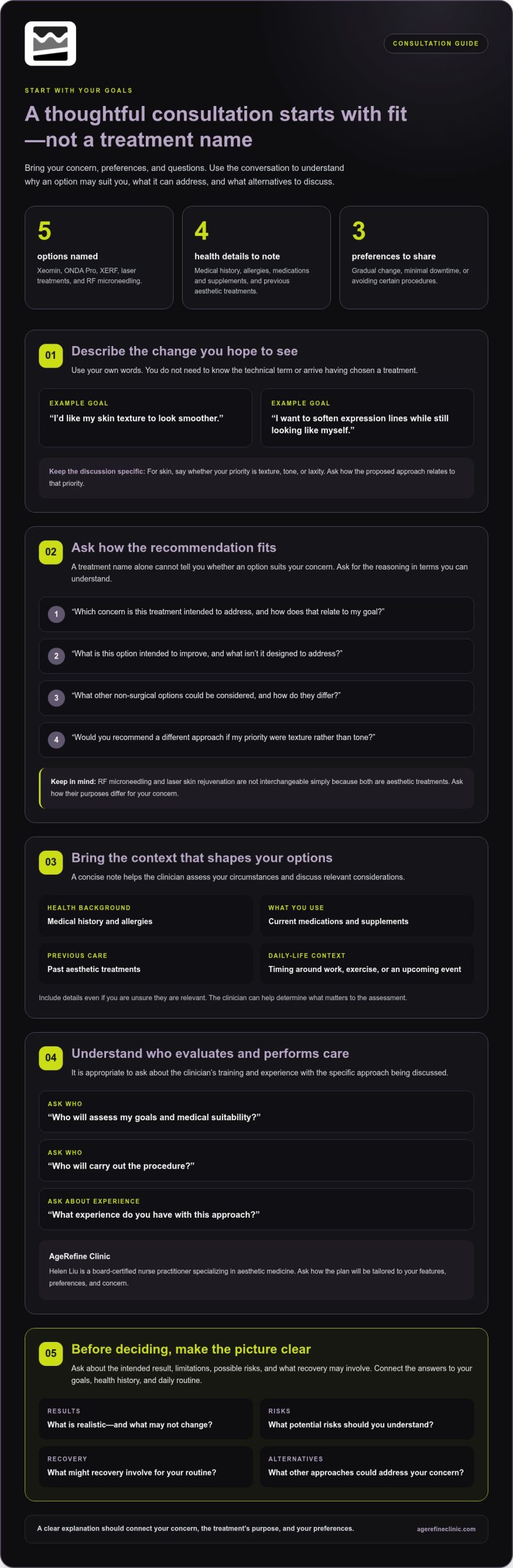
Use your own words to describe the concern and the change you hope to see. You might say, “I’d like my skin texture to look smoother,” or “I want to soften the appearance of expression lines while still looking like myself.” You don’t need to know the technical term or arrive with a treatment in mind.
Be specific about what a comfortable, natural-looking result means to you. Your priorities may include gradual change, minimal downtime, or avoiding certain procedures. Sharing them helps the clinician explain whether a recommendation fits and gives you a useful starting point for the questions to ask during aesthetic consultation. Whether you are consulting on clinical treatments or planning bespoke colour transformations with hair specialists like shampooavenue.com.au, articulating your aesthetic expectations is key to achieving a lived-in, natural look.
What information to have ready
Bring a concise note about relevant medical history, allergies, current medications, supplements, and previous aesthetic treatments. Include details you’re unsure are relevant. The clinician can help determine what matters to the assessment and discuss any considerations that may affect your options.
Also list practical questions about timing, recovery, and daily life. For example, ask how the recommended approach might fit around work, exercise, or an upcoming event. If a concern feels personal or difficult to explain, you can still raise it. Be honest about what you hope to change and take the time you need to understand your options before choosing a next step.
Questions about provider qualifications, goals, and treatment fit
A treatment name alone doesn’t tell you whether an option suits your concern. A useful recommendation connects your goal with the reason for considering a particular approach and leaves room to discuss alternatives. Your questions should help you understand that reasoning, not simply compare procedure names.
Questions that connect your concern to a treatment
Start by asking, “Which concern is this treatment intended to address, and how does that relate to my goal?” Then ask what other non-surgical approaches might be appropriate and how their purpose differs. This keeps the discussion centered on what you hope to change rather than on a popular device or treatment.
Describe the feature you want to discuss without trying to diagnose it yourself. For skin, you might ask whether your priority is texture, tone, or laxity, and how the proposed approach relates to that priority. RF microneedling and laser skin rejuvenation aren’t interchangeable simply because both are aesthetic treatments. Ask the clinician to explain the rationale in terms you can understand.
- “What is this option intended to improve, and what isn’t it designed to address?”
- “How does it align with the result I described?”
- “What other non-surgical options could be considered, and how do they differ?”
- “Would you recommend a different approach if my priority were texture rather than tone?”
For broader context on procedures and approaches in the field, AgeRefine Clinic’s aesthetic medicine guide for Irvine can help you prepare for a more focused conversation.
Questions about qualifications and individualized care
It’s appropriate to understand who evaluates you and who performs the treatment. Ask, “Who will assess my goals and medical suitability?” and “Who will carry out the procedure?” You can also ask about the clinician’s training and experience with the specific modality being discussed. Their background in aesthetics and familiarity with the treatment are useful parts of an informed conversation.
At AgeRefine Clinic, Helen Liu is a board-certified nurse practitioner specializing in aesthetic medicine. Ask questions specific to the treatment you’re considering, such as, “What experience do you have with this approach?” and “How will you tailor the plan to my features, preferences, and concern?” Clear answers help you understand how the recommendation is individualized.
Listen for an explanation that connects your concern, the treatment’s purpose, and your preferences. If those pieces don’t connect, ask for clarification or another option. You can explore AgeRefine Clinic’s aesthetic care as you consider which goals and questions to bring to your consultation.
Questions about aesthetic treatment results, risks, and recovery
A considered treatment plan includes more than a hoped-for result. Before deciding, make sure you understand what the option is intended to do, what it may not change, and what the experience could involve for you. These questions can make expectations more practical by connecting them to your goals, health history, and daily routine.
Questions about realistic results and their limits
Ask what a successful result would look like for the specific concern you discussed. You might say, “What change is realistic for me, and what limitations should I understand?” Follow up by asking when changes may become noticeable and how long results may last. The answers depend on the treatment, your individual response, and the plan recommended for you.
Before-and-after photographs can help you understand an aesthetic approach, but they’re examples, not promises. Ask whether the images reflect goals and circumstances comparable to yours, and what differences might affect your outcome. Similar to evaluating portfolios when planning bespoke body art with studios like Sash Tattoo, visual references are best used to align on style and possibilities, though a photo alone cannot predict your individual result.
Questions about risks, side effects, and recovery
Ask which risks and side effects are relevant to the particular treatment and your health history. For an injectable treatment, for example, ask about temporary effects such as bruising, swelling, redness, or tenderness, as well as less common but more serious complications. Details vary by modality, so request an explanation specific to the proposed procedure rather than relying on a general list.
Useful questions include:
- “What side effects are expected, and which symptoms should prompt clinical follow-up?”
- “What steps do you take to assess whether this treatment is appropriate for me?”
- “What might recovery involve, and when could I return to my usual activities?”
- “What aftercare should I follow, and how can I reach the clinic with a treatment-related concern?”
Ask for guidance that fits your schedule. If you have a work commitment, travel, or an important event coming up, mention it and ask how it may affect timing. Don’t assume every procedure has the same downtime or aftercare needs. A treatment-specific discussion gives you a clearer basis for planning.
Make your questions specific to the modality. If you’re discussing ONDA Pro body contouring, for example, ask about its intended role, expected response, and relevant recovery considerations. AgeRefine Clinic’s ONDA Pro body-contouring guide provides treatment-specific context to complement those questions.
Before you leave, summarize what you’ve understood: the intended outcome, its limitations, possible risks, and what to expect afterward. If an answer is unclear, ask for it in plain language or request written aftercare instructions. You can take time to consider the recommendation before moving forward.
Questions that make treatment plans, fees, and maintenance easier to compare
A treatment plan is more than a quoted fee. To understand the full commitment, compare what each approach involves: the proposed method, expected timeline, number of visits, recovery considerations, possible maintenance, and follow-up. Asking about each detail helps you distinguish between plans that may sound similar at first but differ in practice.
Questions about fees and the full commitment
Ask for an itemized explanation of what the quoted fee covers and whether follow-up visits, recommended products, or other parts of care are separate. If the recommendation involves more than one visit, ask what determines the schedule and whether each visit has a separate fee. Request clear terms in writing before agreeing so you can review the plan without relying on memory.
Treatment plans are individualized, so don’t assume an approach always requires one visit or a series. Ask, “What would the plan involve for my goals, and why?” A useful answer should connect the proposed visits to the treatment being discussed. If bio-revitalization is part of your conversation, the bio-revitalization treatment guide offers context on how approaches can differ.
Questions about maintenance and alternatives
Ask whether maintenance may be recommended, what factors influence its timing, and what a future follow-up would involve. You can also ask what happens if you wait, adjust the plan, or decide against treatment. These are reasonable parts of shared decision-making. An individualized recommendation should account for your preferences and the practical commitment involved.
For each option discussed, use a simple comparison record. Write down the clinician’s answers rather than relying on memory or comparing only the first fee mentioned.
| Compare | What to record |
|---|---|
| Goal | Concern addressed and intended result |
| Visits | Proposed number, spacing, and reason |
| Recovery | Expected downtime and daily-life considerations |
| Risks | Relevant risks and how they’re discussed |
| Fees | What’s included and any separate costs |
| Follow-up | Maintenance, review visits, or aftercare |
Once you’ve filled this in, look for the approach that best aligns with your goal, comfort level, schedule, and understanding of the full plan. A lower initial fee may not reflect the whole commitment, just as a more involved plan isn’t automatically the right fit. Ask for clarification wherever the comparison feels incomplete.
For a personalized discussion of your goals and treatment options, schedule an aesthetic consultation with AgeRefine Clinic.
How to use consultation answers for next steps in Irvine
A consultation is most useful when you leave with enough clarity to make a considered choice. You don’t need to decide during the appointment. Review what you heard, compare it with your priorities, and note anything you still want explained. The questions you bring matter, but so does how you use the answers afterward.
A simple way to review your answers
Go through your notes and mark each question as answered, needs clarification, or not relevant to your goals. This makes gaps visible and helps separate what you understand from what remains uncertain. If an answer needs clarification, write down what you want explained in plain language.
Compare each option against your own priorities, not its popularity or how often you’ve seen it discussed. A plan that fits your goals and preferences may be more meaningful than a trending treatment that doesn’t address your main concern. Consider whether the recommendation makes sense to you and whether you’re comfortable with the practical commitment involved.
- Are my goals reflected in the recommendation?
- Do I understand why this option was suggested and what alternatives were considered?
- Can I explain the relevant risks, recovery, fees, and follow-up in my own words?
- What questions remain before I feel ready to choose?
If you’re comparing more than one approach, keep your notes together. Record what each option is intended to address, its proposed timeline, and the aspects of care that matter most to your routine. This makes it easier to revisit the discussion without relying on memory or feeling rushed into a choice.
What a thoughtful next step can look like
A patient-centered plan should reflect your stated goals, preferences, and clinical assessment. The next step may be moving forward with a recommendation, asking for more information, adjusting the approach, or deciding to wait. If important questions remain unanswered or the plan doesn’t align with what you discussed, pause and seek clarification before agreeing to treatment.
In Irvine, AgeRefine Clinic is led by Helen Liu, a board-certified nurse practitioner specializing in aesthetic medicine. Your consultation is an opportunity to discuss your concerns and understand suitable options in context. No particular outcome can be promised, and your next step should be based on an informed conversation about your individual needs.
Once you’ve reviewed your notes, you can explore AgeRefine Clinic’s aesthetic services and consider which options you’d like to discuss further. A clear decision may take time. It should feel like yours.
Let your next step reflect what matters to you
The most useful result of a consultation is not simply a treatment choice. It’s greater confidence that your decision reflects your priorities, comfort, and understanding of what comes next. Your questions support your judgment, but they don’t replace it. If you need more time, take it. If a detail is unclear, ask for an explanation before moving forward.
Aesthetic care can be approached thoughtfully and at your own pace. Your preferences deserve to be part of the conversation, whether you’re ready to explore an option or still weighing what feels right. AgeRefine Clinic offers non-surgical aesthetic and wellness treatments in Irvine, serving clients in Orange County, in a practice led by Helen Liu, a board-certified nurse practitioner specializing in aesthetic medicine.
When you’re ready to explore possible next steps, explore AgeRefine Clinic’s aesthetic services. Bring your questions, share what matters to you, and make a decision that feels informed and considered.
Frequently Asked Questions
How should I prepare for an aesthetic consultation?
Prepare a concise note with your goals, concerns, relevant medical history, medications, allergies, and previous aesthetic treatments. Add questions about outcomes, risks, recovery, fees, and follow-up. If you have photos that help explain the look you’re hoping for, bring them as conversation references, not as a promise of a particular result. You don’t need to choose a treatment in advance.
Can I decide not to have treatment after an aesthetic consultation?
Yes. A consultation gives you a chance to understand your options and consider whether a proposed plan feels right; it doesn’t obligate you to proceed. Take your notes home, review the recommendation, and consider how it fits your goals and circumstances. If a question comes up afterward, write it down and raise it before making a decision. Feeling comfortable and informed matters more than deciding quickly.
Should I ask about risks even if a treatment is non-surgical?
Yes. Non-surgical treatments can still involve risks, and relevant concerns vary by procedure and individual health factors. Ask which side effects are more likely, whether there are less common concerns to understand, what recovery may involve, and what follow-up is appropriate. If a term is unfamiliar, ask for an explanation in plain language. The answer should relate to the treatment being discussed and the health information you’ve shared.
How do I compare two aesthetic treatment recommendations?
Compare each recommendation using the same criteria: how it relates to your goal, its expected outcome and limitations, potential risks, recovery, visits, fees, and maintenance. Ask why each approach was suggested and what alternatives were considered. For example, if two options address different aspects of a skin concern, clarify which priority each is intended to support. A written comparison can help you review the differences without relying on memory or popularity.
Can I ask about treatment alternatives during my consultation?
Yes. Ask which other approaches may address your concern and how their goals, limitations, recovery, and ongoing care differ. You can also ask what choosing to wait or have no treatment would mean for your plan. This helps make the discussion more complete without assuming every option suits every person. In an Orange County consultation, use your own priorities, rather than a trend, to guide which alternatives you want to understand.
What if I have a medical condition or take medication?
Tell the clinician about relevant health conditions, medications, allergies, and previous procedures before discussing a treatment plan. Ask whether any of these details may affect suitability, risks, timing, or aftercare. Bring an up-to-date medication list if that’s easier than recalling names during the appointment. Don’t stop or change a prescribed medication based on general information; discuss any concerns with the appropriate clinician as part of your individual assessment.
How long does an aesthetic consultation take?
The time can vary depending on the concerns you bring, your health history, and how much discussion your questions require. To use the appointment well, write down your main priorities and group related questions, such as those about recovery and aftercare. If the conversation feels rushed or an answer isn’t clear, say so and ask for clarification before deciding. You can also note what remains unanswered and follow up before agreeing to a plan.