A stronger core and tighter skin are different goals. For post-pregnancy belly tightening in Irvine, the right approach depends on what changed: exercise can strengthen abdominal muscles, but usually cannot tighten loose skin. Celebrity transformations may look simple, yet no single routine addresses every postpartum concern.
It’s understandable to want your abdomen to feel and look more like your own again. Start by identifying whether your main concern is skin laxity, abdominal muscle separation, or both, since each may call for a different approach.
This article explains how fitness and aesthetic treatments fit into post-pregnancy tightening, and how abdominal stretching and diastasis recti can affect your options. You’ll learn what these changes mean for your core and skin, and when non-invasive treatments may be relevant.
Key Takeaways
- Learn why celebrity-inspired routines may not address every postpartum concern, and how skin laxity differs from reduced core strength.
- Understand how diastasis recti can affect abdominal function and why core-focused movement matters.
- See how pregnancy-related stretching can influence the appearance and support of the abdominal wall.
- Explore how treatment goals differ, including where a non-invasive fat-reduction option such as Onda Pro may fit.
How do celebrities get rid of loose skin after pregnancy?
Celebrity photos rarely show which changes came from time, lifestyle, or treatment. The right approach depends on whether your concern is loose skin, excess fat, or abdominal muscle separation.
Lifestyle and Skin-Tightening Approaches
Lifestyle approaches support general recovery and muscle conditioning, but they don’t reliably remove loose skin. Pregnancy lasts an average of 40 weeks, according to the National Institutes of Health. A woman in an average weight range for her height and body frame should gain 25-35 pounds during pregnancy, according to the Centers for Disease Control and Prevention.
Postpartum routines can include hydration, a 30-minute walk, or 30 minutes of yoga or Pilates. Some routines also use 5 lb free weights for muscle strengthening. Thermage FLX, Sofwave, and Renuvion are named skin-tightening approaches; their methods and suitability differ. Exercise can strengthen abdominal muscles, but usually cannot tighten loose skin.
Treatments for the Belly and Other Areas
Loose skin can affect the belly, thighs, and other areas, so treatment goals depend on the area and concern. Non-surgical skin-tightening options discussed in Irvine include Thermage FLX and Sofwave; Renuvion is another approach. These treatments are not interchangeable with fat reduction or muscle repair. Laser hair removal addresses unwanted hair, not skin laxity.
Non-surgical belly tightening in Irvine can include energy-based skin treatments. Each option targets a different concern, so it’s important to distinguish loose skin from excess fat.
Comparing Tummy Tuck and Other Treatments
A tummy tuck removes excess skin and tightens abdominal muscles and fascia. Liposuction targets fat, while non-surgical tightening focuses on skin laxity. Neither removes skin as a tummy tuck does.
People considering a tummy tuck generally have excess abdominal skin or muscle laxity and are ready for surgery. Timing depends on postpartum healing, weight stability, and breastfeeding plans. Surgery carries risks, and recovery involves healing and activity restrictions; specific risks and recovery needs vary by procedure and patient.
In California, insurance coverage depends on policy terms and whether a procedure is considered medically necessary. The cost of a tummy tuck in Irvine depends on the case, including the procedure’s scope and related care; pricing is provided after a quote request.
Diastasis recti and core function
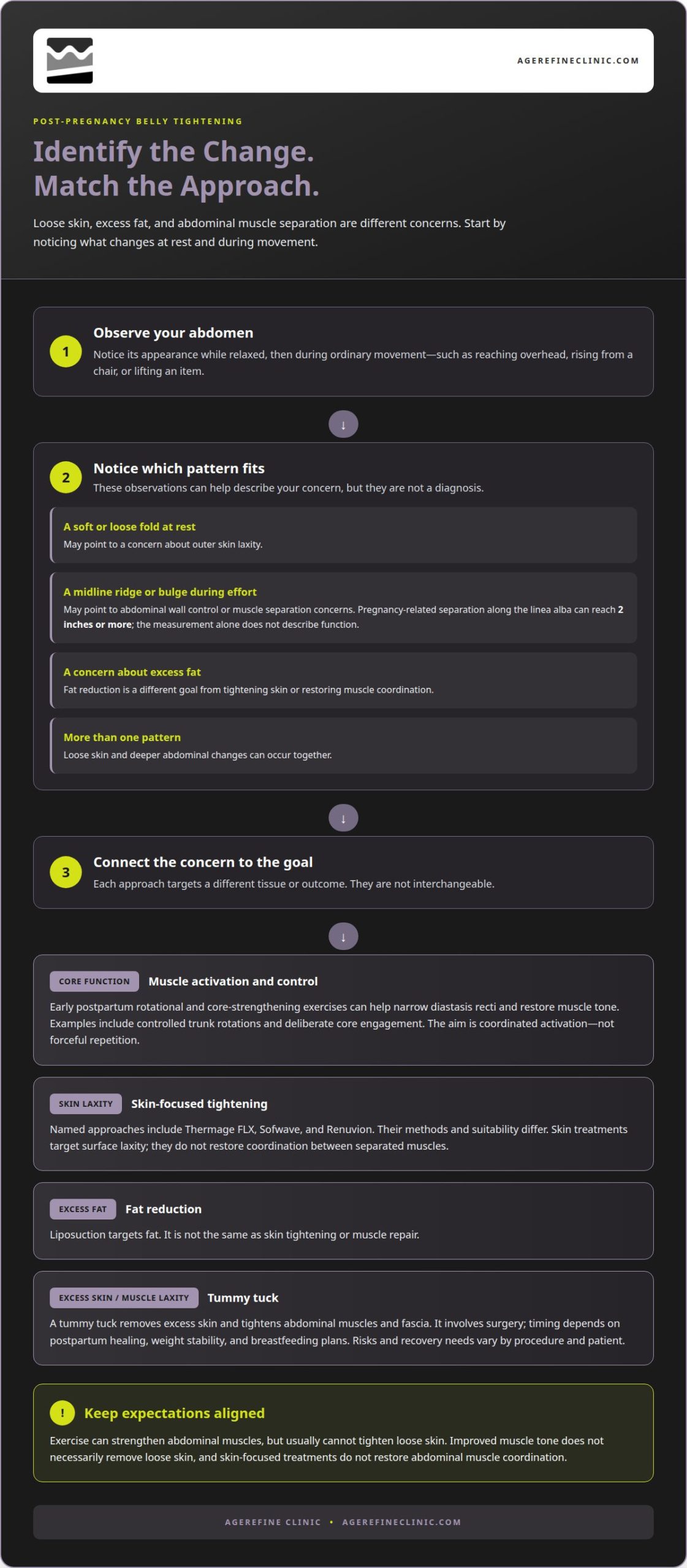
Diastasis recti describes separation between the rectus abdominis muscles along the linea alba, the connective tissue at the abdomen’s midline. Pregnancy-related separation of the linea alba can reach 2 inches or more. The measurement alone doesn’t describe how well the abdominal wall coordinates or supports movement. A visible midline ridge during effort may also draw attention to the area, but appearance and function are separate considerations.
Core function matters in everyday life, not just appearance. The abdominal wall works with the back and pelvic region during movements such as lifting a baby from a crib, carrying a car seat, or getting up from the floor. Notice how your abdomen responds: does the midline bulge, is tension difficult to control, or does movement feel less coordinated? These observations can help distinguish a skin concern from one involving abdominal control.
Early postpartum rotational and core-strengthening exercises can help narrow diastasis recti and restore muscle tone. Controlled trunk rotations and deliberate core engagement are examples of these movement categories. The aim is coordinated activation, not forceful repetition. Progress according to movement quality, comfort, and your ability to control the abdominal wall during an activity, rather than simply counting repetitions.
Skin-focused tightening and core training address different tissues. A skin treatment targets surface laxity; it doesn’t restore coordination between separated muscles. Likewise, improved muscle tone doesn’t necessarily remove loose skin. When choosing a next step, consider whether your main concern is a midline bulge during movement, reduced control during daily tasks, loose skin, or a combination. For example, someone lifting an infant may prioritize comfortable, controlled movement before focusing on skin appearance. Separating these goals clarifies the options and keeps expectations aligned with the underlying concern.
Pregnancy-related abdominal wall stretching and laxity
As the abdomen expands during pregnancy, skin and connective tissue accommodate a growing uterus. The linea alba, a connective band between the abdominal muscles, can also stretch. Pregnancy-related separation of the linea alba can reach 2 inches or more. These changes may affect abdominal contour, but surface looseness and deeper structural changes are different concerns.
Skin laxity affects the outer tissue, while abdominal wall laxity involves deeper support. A soft fold that remains while standing may reflect loose skin; a central ridge during effort suggests a different pattern. Both can occur together. Observing your abdomen while relaxed and during ordinary movement can help you describe what you notice, though appearance alone doesn’t establish a diagnosis.
Stretching may also influence how your abdomen responds to posture and daily activity. Notice its contour when reaching overhead, rising from a chair, or lifting a household item. Does the midline dome, or does the skin fold without a visible ridge? These observations can be useful, but they are not diagnostic tests. They can help you explain whether your concern is about the skin, movement, or both.
For post-pregnancy belly tightening in Irvine, identifying the tissue involved helps clarify your options. Skin-focused approaches address the outer layer, while core exercises address muscle activation and control. Neither should be assumed to correct every pregnancy-related change. If you notice a loose fold, note its location and how it changes with posture. If a ridge appears during movement, note which action brings it on. These details can make a discussion of post-pregnancy belly tightening in Irvine more focused on your concerns and desired outcome.
What treatments tighten the belly after pregnancy in Irvine, CA?
Postpartum belly treatments address different concerns: loose skin, excess fat, and reduced abdominal muscle tone. Start by identifying which change matters most, since one approach won’t address every tissue. For example, a skin-focused treatment and a procedure that removes skin have different purposes. Understanding the distinction helps set realistic expectations in Irvine.
Exercise can strengthen abdominal muscles, but usually cannot tighten loose skin. Non-surgical skin-tightening treatments focus on skin laxity, while fat-reduction procedures target fat. These approaches are not interchangeable. If your main concern is a loose fold, skin removal may be more relevant than fat reduction. If you’re concerned about core control, a skin-focused treatment won’t address muscle function.
A tummy tuck removes excess skin and tightens abdominal muscles and fascia. It’s a surgical option for concerns involving both skin and abdominal wall laxity. Non-surgical approaches, by contrast, don’t remove excess skin or surgically tighten fascia. The choice depends on your concern and the amount of skin or fat involved.
Timing matters, too. Most postpartum body treatments begin 3 to 6 months after delivery, depending on the procedure. Postpartum fat-reduction procedures are often delayed until weight stabilizes, commonly 6 to 12 months after childbirth. These timelines refer to different treatment considerations, not one universal start date. A useful next step is to clarify whether your goal is skin tightening, fat reduction, or abdominal muscle repair.
For a focused discussion of non-invasive aesthetic options, explore treatment considerations and how they relate to your specific concern.
Many postpartum changes may occur within six weeks to a year after birth. This is a reason to assess your concerns before settling on a treatment goal. Consider whether skin laxity, fat, or abdominal muscle function remains your priority, and how that concern shapes your expectations.
A clinician can explain which tissue a proposed approach targets and whether it matches your concern. Keeping your goal specific can also make it easier to compare non-surgical care with surgery and understand what each option is intended to address.
AgeRefine Clinic: Onda Pro
AgeRefine Clinic offers Onda Pro for people whose postpartum concern includes excess fat rather than loose skin or abdominal muscle separation. The distinction matters: fat reduction doesn’t remove excess skin or restore core function. Clarifying your main goal can help you decide whether Onda Pro may suit it.
Skin laxity and diastasis recti call for a different treatment discussion than fat reduction. AgeRefine Clinic also offers XERF, wrinkle relaxer Xeomin, and IV Therapy, each for different aesthetic or wellness goals. Describe the change you want to address to explore which option fits your goal.
For a considered discussion of Onda Pro and your postpartum goals, visit AgeRefine Clinic’s website.
Choose a next step that fits your goals
Start by clearly describing what you want to change: skin laxity, abdominal contour, or another aesthetic concern. For post-pregnancy belly tightening in Irvine, distinguishing these goals can make a discussion about options more focused. A treatment aimed at one concern should not be assumed to address another.
AgeRefine Clinic offers Onda Pro and XERF, as well as wrinkle relaxer Xeomin for a different aesthetic purpose. A useful discussion begins with your priorities and how each option relates to them. If you’re considering a non-invasive approach, share which area concerns you and what kind of change you hope to address.
Contact AgeRefine Clinic to discuss your options and take a considered next step toward care that reflects your goals.
Frequently Asked Questions
What is postpartum belly?
A postpartum belly describes abdominal changes that remain after pregnancy, such as softer skin, a fuller contour, or changes in muscle support. It isn’t one specific condition, and its appearance can vary with posture, movement, and individual recovery. For example, a lower-abdominal fold may mainly involve skin, while a midline bulge during effort can point to a core-function concern. Those differences help determine which options may be relevant.
Can diastasis recti be repaired with postpartum belly tightening, and what does treatment involve?
It depends on what “tightening” means: skin-focused treatments don’t repair separated abdominal muscles. Core-focused rehabilitation uses controlled movements to improve muscle activation and coordination. A tummy tuck is a surgical procedure that can tighten abdominal muscles and fascia while removing excess skin. These approaches serve different goals. In Irvine, distinguishing a skin concern from a midline bulge or reduced core control can help frame a useful treatment discussion.
How long should you wait after childbirth or breastfeeding before belly tightening surgery?
Most postpartum body treatments begin 3 to 6 months after delivery, depending on the procedure. Belly tightening surgery should be timed around postpartum healing, weight stability, and breastfeeding plans.