Whether peptide therapy is FDA approved depends on the specific medicine. Some peptide medicines, including semaglutide, tirzepatide, insulin, and oxytocin, are FDA-approved for particular uses, but that does not mean every peptide treatment is approved. The U.S. Food and Drug Administration (FDA) says compounded drugs are not FDA-approved finished drugs. This distinction matters, especially when an injectable peptide is promoted for uses that lack the same level of human evidence.
It’s understandable to want clear information before considering a treatment that may affect your health. Peptides are short chains of amino acids, and medicines made from them can differ substantially in evidence, approved uses, and safety profiles. This article explains which peptide medicines have FDA approval and how human clinical evidence differs for unapproved injectable peptides. It also outlines safety questions to consider, so you can better understand what approval does and does not tell you.
Key Takeaways
- Learn why approval applies to a medicine’s specific labeled use, not to peptides as a category.
- See how human trial evidence can differ between established medicines and unapproved injectable peptides.
- Understand why formulation, purity, sterility, and known side effects matter when weighing safety.
- Explore what a careful, individualized approach to peptide therapy can take into account.
Evidence and safety concerns for unapproved peptides
Peptide products differ in evidence, formulation, and oversight. Approval status can affect what is known about a product’s safety.
Safety testing and medical monitoring
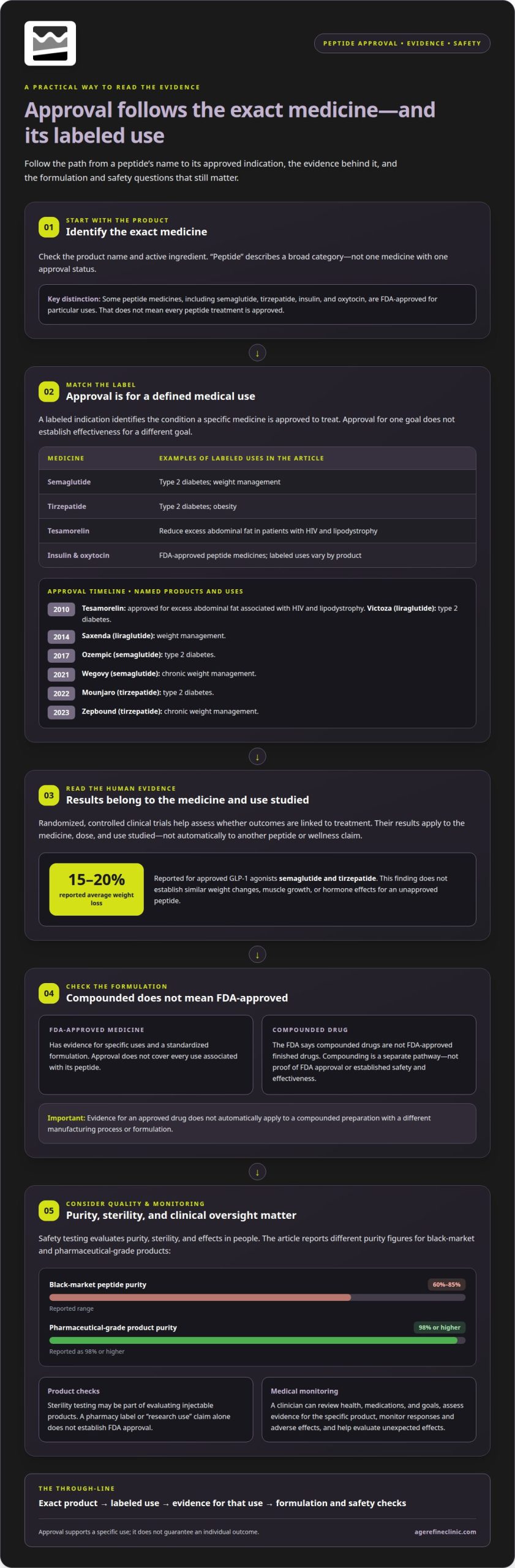
Safety testing evaluates a medicine’s purity, sterility, and effects in people. FDA-approved peptide medicines have evidence for specific uses and standardized formulations; unapproved injectables may lack comparable human evidence. Reports describe black-market peptide purity ranging from 60% to 85%, compared with 98% or higher for pharmaceutical-grade products. Sterility testing may be part of evaluating injectable products. Consult a clinician before use, and report unexpected effects promptly.
Medical supervision means a clinician reviews your health, medications, and treatment goals, then monitors your response and any adverse effects. This matters because side effects are better understood for approved drugs than for unapproved peptides. A clinician can also assess whether a claim, such as weight loss, is supported by evidence for that specific product.
Approval status of compounded peptides
No. The U.S. Food and Drug Administration says compounded drugs are not FDA-approved finished drugs. Compounding is a separate pathway, not proof that a peptide has FDA approval or established safety and effectiveness.
Compounding restrictions have changed. In late 2023, the FDA restricted 19 widely used peptides; in February 2026, 14 of those 19 were expected to move to Category 1. BPC-157 is listed as ineligible for compounding, while ipamorelin remains in Category 2. Advisory committee votes on peptides in July 2026 were recommendations, not drug approvals.
How much do FDA-approved peptide medicines cost in the United States? There’s no single price: cost depends on the medication, dose, pharmacy, and insurance coverage. A specific price is provided after a quote request.
To verify a product’s status, compare its exact name, active ingredient, and labeled use with FDA approval records. A pharmacy label or a “research use” claim alone doesn’t establish FDA approval.
If you’re considering peptide therapy, start with a healthcare professional who can review your health history, discuss evidence for the intended use, and monitor treatment. Bring the product name and any claims about its effects to the discussion.
FDA-approved peptide medicines and their labeled indications
FDA approval applies to a medicine for defined medical uses, not to every use associated with its peptide. Semaglutide and tirzepatide illustrate how one active ingredient can have distinct approved indications.
Labeled indications for approved peptide medicines
A labeled indication identifies the condition a medicine is approved to treat. It helps patients distinguish evidence for a specific medical use from broader claims about healing, weight, or wellness.
Tesamorelin was approved in 2010 to reduce excess abdominal fat in patients with HIV and lipodystrophy. Semaglutide is approved for type 2 diabetes and weight management; tirzepatide is approved for type 2 diabetes and obesity. Insulin and oxytocin are also examples of FDA-approved peptide medicines, though their labeled uses vary by product.
These examples show why the exact medicine and indication matter. Approval for weight management, for instance, doesn’t establish effectiveness for a different goal. Evidence for an approved drug also doesn’t automatically apply to a compounded preparation with a different manufacturing process or formulation. Medical care considers the specific product, its label, the patient’s health, and relevant side effects.
Approval years for peptide medicines
Approval years provide context, but the indication remains essential. Semaglutide was first approved in the United States as Ozempic for type 2 diabetes in 2017, then as Wegovy for chronic weight management in 2021. These dates reflect approvals for different labeled uses, not blanket approval of every semaglutide product or purpose.
Liraglutide followed a similar pattern: Victoza was approved for type 2 diabetes in 2010, and Saxenda for weight management in 2014. Tirzepatide was first approved as Mounjaro for type 2 diabetes in 2022, then as Zepbound for chronic weight management in 2023. Tesamorelin’s 2010 approval addresses excess abdominal fat associated with HIV and lipodystrophy.
For treatment decisions, compare the medicine’s exact name and intended use with its FDA-labeled indication. Approval can establish evidence for that use, but not guarantee an individual outcome. A clinician can explain how approved peptide medicines differ from compounding and whether the labeled indication fits the medical goal. For a discussion of peptide therapy options, consider the evidence and intended use together.
Human evidence and clinical trials for injectable peptides
A peptide’s biological activity doesn’t establish that an injectable treatment works in people. Clinical trials help distinguish a proposed mechanism from evidence of a treatment’s effectiveness, benefits, and risks.
FDA-approved drugs must demonstrate safety and effectiveness in humans, including through randomized, controlled clinical trials. Random assignment and comparison groups help researchers assess whether outcomes are linked to the treatment rather than other factors. Results apply to the medicine, dose, and use studied, not automatically to another peptide or wellness claim.
Approved GLP-1 agonists semaglutide and tirzepatide provide a human-evidence example: reported average weight loss is 15% to 20% of body weight. That finding relates to those medicines and their studied uses. It does not establish that an unapproved peptide produces similar weight changes, supports muscle growth, or affects a hormone in the same way. Similarly, as next-generation multi-agonists continue to be evaluated in laboratory settings, researchers seeking to buy Retatrutide Australia focus strictly on analytical purity and verified sourcing for their trials.
By contrast, the unapproved injectable peptides discussed here have not gone through randomized, controlled clinical trials. That leaves important questions about human benefits, side effects, and suitable treatment protocols less clearly answered. Laboratory research or a proposed biological pathway cannot fill those gaps by itself.
AOD-9604 illustrates why trial results matter. In 2024, the FDA voted against it after it failed its clinical trials. A proposed weight-related effect was not enough to establish effectiveness. The example is a reminder to separate a product’s intended purpose from evidence showing meaningful outcomes in people.
If you’re considering an injectable peptide, assess the evidence for the exact substance and intended use. Look for human clinical trial results, the outcomes measured, and reported concerns, rather than relying on claims about wellness or hormone activity. Approved drugs have a defined regulatory status; a similar name or biological target doesn’t make another product equivalent. This distinction matters before treatment, especially when evidence about long-term effects remains limited.
Are peptide therapies FDA approved in the United States?
Some peptide medicines are FDA-approved in the United States, but peptide therapy as a broad category is not. The approval attaches to a specific medicine and labeled use. A review estimated that 10 natural peptides have been approved since 1923, while a 2023 review identified 6 newly approved peptide drugs that year.
Examples show how specific that status is. Bremelanotide was approved in 2019 as Vyleesi for hypoactive sexual desire disorder in premenopausal women. The FDA has approved elamipretide (Forzinity), also known as SS-31, for Barth syndrome under accelerated approval. By contrast, thymosin alpha-1 is not approved in the United States; an FDA panel voted against it in 2024.
Compounding is a separate pathway under Sections 503A and 503B, not FDA approval of a finished drug. More than 80 peptide drugs are FDA-approved overall in the United States, but that number does not mean every peptide sold or compounded has approval. BPC-157 is explicitly listed as ineligible for compounding. A product’s regulatory status depends on its specific substance and route, not simply its peptide classification.
Compounding policy also involves distinct decisions. In July 2026, FDA advisory committee members gave favorable votes to six peptides for the 503A Bulks List and declined to recommend emideltide. Those votes were non-binding recommendations, not drug approvals. For example, a favorable committee vote does not establish an approved indication, demonstrated effectiveness, or FDA approval of an injectable product.
For a practical discussion of peptide treatment goals and how they relate to approval status, connect with a clinician. Bring the exact product name and intended use; those details help distinguish an approved medicine from a compounded peptide.
AgeRefine Clinic: Peptide Therapy
AgeRefine Clinic offers peptide therapy for people exploring this option as part of a wellness or aesthetic care plan. The distinction between a peptide treatment and an FDA-approved medicine matters: approval applies to a specific drug and labeled use, not every therapy described as peptide-based.
A thoughtful discussion can focus on your goals, the exact peptide being considered, evidence in humans, and questions about approval status and safety. This can help set clear expectations and distinguish a wellness interest from a medical condition requiring care beyond an aesthetic clinic. Peptide therapy is not a substitute for an FDA-approved medicine prescribed for its labeled indication.
If you’re considering peptide therapy and want to discuss your questions, contact AgeRefine Clinic.
Choose a next step grounded in your goals
Whether peptide therapy is FDA approved is only one part of making an informed treatment choice. Connect the treatment’s intended use with your personal goals, medical context, and the evidence for that specific option. A clear conversation can help distinguish wellness interests from needs that call for care beyond an aesthetic setting.
At AgeRefine Clinic, peptide therapy is one option within a broader aesthetic and wellness offering. For different goals, the clinic also offers Onda Pro treatment, XERF, and wrinkle relaxer Xeomin. Each treatment serves a distinct purpose, so start by discussing what you hope to address rather than assuming one approach fits every concern.
For a thoughtful conversation about your goals and peptide therapy, contact AgeRefine Clinic. You can take the next step with clarity and care.
Frequently Asked Questions
What are peptides?
Peptides are short chains of amino acids that can act as signals in the body. Some influence processes such as hormone activity; insulin is a familiar peptide medicine. The human body contains more than 7,000 peptides, and a peptide’s role depends on its structure and biological activity. That’s why the word “peptide” alone doesn’t identify a treatment or predict its effects.
Is BPC-157 FDA-approved?
No. BPC-157 is not FDA-approved, and it’s listed as ineligible for compounding. A product label describing it as “research use” doesn’t make it an approved medicine or establish safety for human treatment. If you encounter a BPC-157 product, distinguish claims about laboratory research from evidence of safe, effective use in people.
Is there proof that injectable peptides work?
Human evidence exists for specific approved peptide medicines, but it doesn’t establish the effectiveness of every injectable peptide. For a particular product, look for trials involving the same substance and intended use, with outcomes measured in people. A result for one medicine cannot establish that another peptide improves energy, changes body composition, or supports recovery.
Quick Answer: Is Peptide Therapy Legitimate?
Some peptide medicines are FDA-approved treatments for specific labeled uses, but the broad term “peptide therapy” doesn’t guarantee approval or proven benefit. Whether peptide therapy is FDA approved depends on the exact product and its indication. Start by identifying the active ingredient and intended use, then discuss whether evidence supports that treatment goal.
The FDA Landscape: What’s Actually Legal?
FDA-approved medicines and compounded drugs follow different pathways. Compounding under Sections 503A and 503B doesn’t itself make a finished drug FDA-approved. Compounding categories can also differ by peptide and route: non-injectable GHK-Cu is in Category 1, while its injectable-route nomination was withdrawn. A category or committee recommendation isn’t the same as FDA approval.
What Is Medical-Grade Peptide Therapy?
“Medical-grade” by itself doesn’t tell you whether a peptide is FDA-approved or supported by human evidence. Clarify the product’s active ingredient, route, intended use, and approval status before considering treatment. For people in Orange County, AgeRefine Clinic in Irvine offers peptide therapy. Any discussion of treatment should distinguish the service from the regulatory status of a specific product.