Loose skin on the arms and around the elbows can develop with age, weight changes, and reduced skin elasticity. Arm tightening treatments without surgery may gradually improve mild to moderate laxity by stimulating collagen, but they do not remove excess skin. Expect a gradual change, not the result of a surgical lift.
If your skin feels less firm than before, it can be frustrating, and exercise may improve muscle tone without necessarily addressing loose skin. A personalized assessment can help clarify what treatment may realistically achieve.
This guide explains why skin becomes loose on the arms and elbows, how nonsurgical options work, and why treatments may be combined. It also covers realistic results and timelines, the limits of these approaches, and when surgical skin removal may be a better fit.
Key Takeaways
- Learn how radiofrequency may support firmer-looking arm skin and what factors affect its suitability.
- Compare non-surgical approaches with an arm lift by considering the amount of excess skin and the trade-offs involved.
- See how combining treatments may address different concerns, and why a thoughtful plan matters more than simply adding procedures.
- Understand what gradual changes may look like and which signs suggest a non-surgical approach may not meet your goals.
What Causes Loose Skin on the Arms and Elbows?
Nonsurgical options for upper-arm laxity include radiofrequency, focused ultrasound, and topical skin care. These approaches aim to support collagen or improve the skin’s surface, rather than remove excess tissue. Suitability depends partly on skin looseness after aging, weight loss, or pregnancy.
Skin stretches as weight changes, and it may not fully retract when the underlying support has weakened. Aging also affects collagen: production drops by about 1% every year starting in the mid-20s. Pregnancy can stretch skin through body changes, while substantial weight loss may leave more visible laxity. These causes matter because a treatment that addresses mild firmness concerns may not substantially change hanging skin.
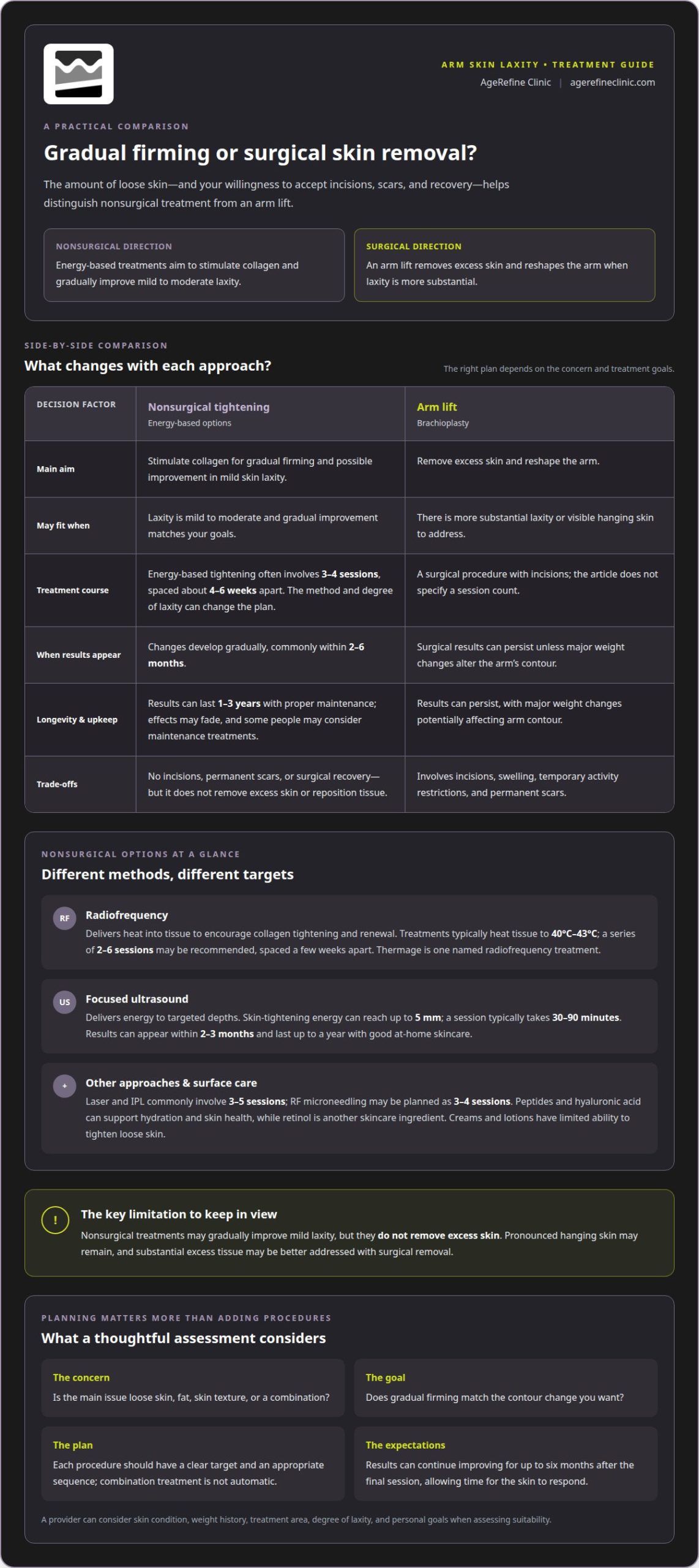
Radiofrequency delivers heat into tissue to encourage collagen tightening and renewal. Treatments typically heat tissue to between 40°C and 43°C, and a series of 2 to 6 sessions may be recommended, spaced a few weeks apart. Thermage is one named radiofrequency treatment; the treatment plan depends on the area and the degree of laxity. During consultation, a provider can assess whether the concern is skin looseness, fat, or both. That distinction guides whether skin tightening or contouring is the more relevant goal.
Focused ultrasound works differently, delivering energy to targeted depths. Skin-tightening energy can reach depths of up to 5 mm, and a session typically takes 30 to 90 minutes. For surface care, peptides and hyaluronic acid can support hydration and skin health, while retinol is another topical ingredient used in skincare. Creams and lotions have limited ability to tighten loose skin, so they shouldn’t be confused with energy-based treatment.
When choosing a provider for arm skin tightening in Orange County, look for experience relevant to your concern and a consultation that considers your skin, weight history, and goals. Ask how the proposed method addresses your specific concern, what improvement is realistic, and whether the laxity may be too extensive for nonsurgical treatment. Clear answers can help you make an informed decision.
Why consider non-surgical skin tightening?
For anyone considering arm tightening treatments without surgery, the key question is whether gradual firming matches their goals. The degree of laxity, along with willingness to accept scars and recovery, helps distinguish nonsurgical care from surgery.
Nonsurgical Treatments Compared With Surgery
Nonsurgical procedures use energy to stimulate collagen and may gradually improve mild skin laxity. They may suit people seeking change without incisions, permanent scars, or surgical recovery. Their limits matter: these procedures do not remove excess skin or reposition tissue, so pronounced hanging skin may remain.
An arm lift, or brachioplasty, surgically removes excess skin and reshapes the arm. It can address more substantial laxity, but involves incisions, swelling, temporary activity restrictions, and permanent scars. Nonsurgical contouring may suit mild to moderate laxity, while visible hanging skin may be better addressed with surgical removal.
Treatment Sessions and Result Longevity
Energy-based tightening often involves 3 to 4 sessions, spaced about 4 to 6 weeks apart. Results develop gradually, commonly appearing within 2 to 6 months, and can last 1 to 3 years with proper maintenance. The method, treatment area, and degree of laxity all affect the recommended course.
Surgical results can persist unless major weight changes alter the arm’s contour. Nonsurgical effects may fade, so some people may consider maintenance treatments. These differences help clarify the trade-off between gradual improvement and surgical reshaping, as well as recovery, skin texture, and personal goals.
Treatment Options and Candidate Suitability
Radiofrequency and ultrasound use energy to support gradual firming; laser and microneedling offer other approaches to skin treatment. Laser and IPL commonly involve 3 to 5 sessions, while RF microneedling may be planned as a series of 3 to 4 sessions. Ultrasound results can appear within 2 to 3 months and last up to a year with good at-home skincare.
A good candidate for arm tightening treatments without surgery typically has mild laxity and understands the limits of gradual improvement. A consultation can distinguish texture concerns from excess tissue and assess whether the expected contour fits your goals. That assessment can also guide the method and treatment schedule, a process emphasized by body-contouring clinics like Body Therapist to ensure expectations match achievable outcomes.
Combining arm-tightening treatments
A combined plan uses different procedures to address distinct concerns, such as skin laxity and surface texture. The aim is to match each method to a specific goal, not simply add treatments. For example, a clinician may first assess whether moderate loose skin is the main concern. Nonsurgical approaches can support gradual change, but they do not remove excess skin or replace surgery when substantial tissue needs removal.
IPL and radiofrequency use different forms of energy, so a combined plan may address more than one aesthetic concern. The treatment sequence matters: the provider should identify the target for each procedure and allow appropriate spacing between sessions. Radiofrequency courses may involve 2 to 6 treatments spaced a few weeks apart. For arm skin tightening, the plan should account for treatment area, skin condition, and how the procedures fit together.
Sofwave and Sculptra are also discussed as a combination of ultrasound-based and injectable approaches. They are not interchangeable: each is delivered differently, so the intended role of each should be clear before treatment begins. For example, practices offering skinvive injections beverly hills demonstrate how microdroplet hyaluronic acid injectables can be utilized alongside collagen-stimulating modalities to improve overall skin hydration and smoothness. Discuss the proposed sequence, the concern each procedure is meant to address, and how progress will be assessed. This keeps the plan focused rather than making combination treatment automatic.
Spacing and expectations are part of the plan. Non-surgical energy treatments are commonly arranged as 3 to 4 sessions, about 4 to 6 weeks apart; the schedule may differ when methods are combined. Results can continue improving for up to six months after the final session. A measured approach gives the skin time to respond and helps the provider assess whether another procedure is appropriate. Combination treatment can support skin tightening goals, but it cannot achieve surgical skin removal.
Expected nonsurgical arm-lift results
Nonsurgical arm treatments aim for gradual firming, not the removal of hanging skin. Energy-based devices can stimulate collagen production, which may improve mild to moderate sagging because collagen and elastin support skin structure. Results can continue to improve for up to six months after the final energy-treatment session, but the change is subtler than surgical reshaping.
Side effects and recovery depend on the procedure. RF microneedling may cause mild redness or swelling for 1-3 days, while PRP arm treatments may cause sensitivity for 1-2 days. Estimated downtime for nonsurgical arm contouring is 0 to 2 days. These effects are generally temporary, but the treatment type and skin response shape the recovery experience.
Brachioplasty, or an arm lift, removes excess tissue and reshapes the arm through incisions. A traditional incision may extend from the elbow to the armpit; a short-scar incision sits within the armpit and limits how much skin can be removed. Scars are permanent, though they may fade over time. Potential downsides include numbness, contour irregularities, swelling, and temporary activity restrictions.
Recovery after brachioplasty requires care to avoid tension on the incision. Movement is restricted during the first two weeks, and more strenuous activity may resume at four weeks, while tension along the incision should still be avoided. Gentle range-of-motion work helps minimize incision tension during the first three months. This trade-off matters: surgery addresses substantial loose skin, while energy-based options focus on gradual firming.
For arm skin texture concerns, discuss RF microneedling for skin texture with AgeRefine Clinic as a possible part of a personalized treatment conversation.
AgeRefine Clinic
AgeRefine Clinic can help you consider your aesthetic goals and whether a nonsurgical approach aligns with them. A personalized discussion can clarify what matters most, such as skin firmness, texture, or the amount of loose skin, and what gradual improvement may realistically address. Nonsurgical treatments may suit mild laxity, while substantial hanging skin may call for a different approach. Understanding that distinction helps set expectations before choosing a treatment path. AgeRefine Clinic offers aesthetic and wellness services, including XERF. Treatment choices should reflect your concerns and goals. Contact AgeRefine Clinic in Irvine to discuss your goals and possible next steps.
Choose a Next Step That Fits Your Goals
Choosing arm tightening treatments without surgery begins with defining what you want to change and what kind of result feels right. Bring your priorities to the conversation: smoother-looking skin, improved firmness, or clarity about whether your concern involves loose skin or contour. A thoughtful plan should connect each proposed treatment to a specific goal, without promising a surgical-level lift from a nonsurgical approach.
AgeRefine Clinic offers Onda Pro and XERF among its aesthetic treatments, as well as wrinkle relaxer Xeomin for a separate concern. A personalized discussion can clarify which options relate to your goals and what a realistic path forward may involve.
Reach out to AgeRefine Clinic to explore your options. A well-informed next step can help you move forward with greater clarity and confidence.
Frequently Asked Questions
Arm Lift vs Non-Surgical Arm Tightening: What Actually Works?
An arm lift removes excess skin; nonsurgical treatments aim for gradual firming and suit milder laxity. The right approach depends on what you want changed. For example, if loose skin hangs noticeably when your arm rests at your side, energy treatments cannot remove that tissue. If your concern is mild loss of firmness, nonsurgical treatment may offer a more measured change without surgical incisions.
Can I Achieve Arm Reduction Without Surgery or Scars?
Nonsurgical approaches are available, but “arm reduction” can mean reducing fat or improving skin firmness, which are different goals. Energy-based tightening may subtly improve mild laxity, but it will not remove substantial loose skin. Fat-reduction treatments address a different concern; Onda Pro is offered for fat reduction, not as an arm skin-tightening treatment. Nonsurgical care avoids arm-lift incisions, but its results are not equivalent to surgery.
Can topical creams tighten loose arm skin?
Topical creams can support hydration and skin health, but have limited ability to tighten loose arm skin. Ingredients such as hyaluronic acid may help with hydration, while retinol and peptides are used in skincare. These products work at the skin-care level; they do not remove stretched excess tissue. Moisturized skin may feel smoother without changing the amount of loose skin beneath the surface.
How many sessions of non-surgical treatments are needed?
Many energy-based arm-tightening plans involve 3 to 4 sessions, usually spaced about 4 to 6 weeks apart. The treatment method and degree of laxity affect the plan. A schedule should also allow time to assess the skin’s response before adding more treatment. This is why a single session shouldn’t be assumed to produce the same change as a planned course.
How many sessions will I need for optimal results?
There isn’t one session count for every method. Radiofrequency treatment plans may involve 2 to 6 sessions spaced a few weeks apart, while RF microneedling plans may use 3 to 4 sessions. These figures describe different treatment approaches, not a combined requirement. The area treated, skin condition, and intended outcome shape the plan, so “optimal” means a course matched to your specific concern.
How much tightening can nonsurgical arm treatments realistically achieve?
Nonsurgical treatments may create subtle firming over time, particularly for mild to moderate laxity. They do not remove excess skin or reposition tissue, so pronounced hanging skin remains beyond their reach. A practical expectation is improved firmness or texture rather than a dramatically smaller arm. Results develop gradually, and weight changes can affect the arm’s contour after treatment.