Skin revitalization doesn’t have to mean an injectable or an operation. XERF is a non-invasive radiofrequency treatment that supports gradual collagen remodeling. Put simply, what bio-revitalization with XERF involves is delivering controlled energy to the skin, with changes developing over time rather than appearing immediately. A typical plan involves three to six sessions, usually spaced four to eight weeks apart.
If you’re considering treatment, it helps to understand what XERF can and can’t do. It may be an option for mild to moderate skin laxity if you prefer a non-surgical approach, but it can’t reproduce the tissue repositioning of a surgical facelift. This guide explains how the treatment works, what can influence session planning and suitability, and how XERF differs from injectables and surgery, helping you consider which approach aligns with your goals.
Key Takeaways
- Understand which personal factors can shape a treatment plan, from the area being treated to your skin’s laxity and aesthetic goals.
- Learn what suitability can depend on, including the degree of skin laxity and how radiofrequency treatment relates to different skin tones and types.
- See how controlled radiofrequency energy works at different tissue depths to support gradual collagen remodeling.
- Clarify how XERF’s approach differs from injectables and surgery, and which concerns each option is designed to address.
How Many XERF Sessions Are Typically Recommended?
XERF is a non-invasive radiofrequency tightening treatment, not a laser. It uses two frequencies, 6.78 MHz and 2 MHz, to deliver controlled heat at different tissue depths. This supports collagen remodeling, which can gradually improve skin laxity, texture, and firmness. The technology uses radiofrequency energy rather than injectable products.
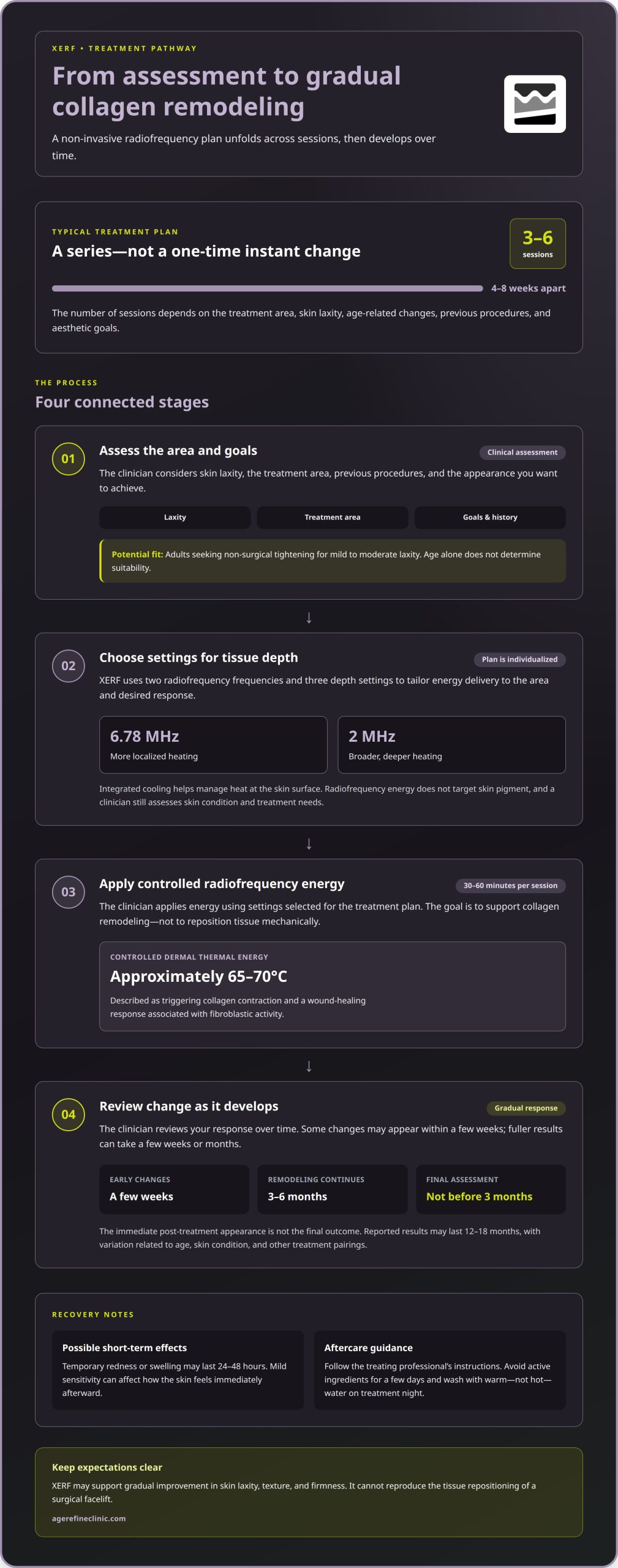
A typical plan involves three to six XERF sessions, spaced four to eight weeks apart. The number depends on the treatment area, skin laxity, age-related changes, previous procedures, and aesthetic goals. A session usually takes 30-60 minutes. During treatment, the clinician assesses the area and goals, selects an appropriate plan, then applies radiofrequency energy using the XERF system. The response is reviewed over time, since tightening develops gradually.
Some changes may appear within a few weeks, while full results can take a few weeks or months. Collagen remodeling continues for three to six months, so an immediate post-treatment appearance isn’t the final outcome. Final assessment shouldn’t occur before the three-month mark. Results may last between 12 and 18 months, with variation related to age, skin condition, and other treatment pairings. Maintenance can be considered as skin changes over time.
After recovery from facelift surgery, XERF may be considered as a possible maintenance treatment. It doesn’t reproduce the mechanical tissue repositioning of a facelift. A qualified provider in the United States should have appropriate clinical credentials, device-specific training, and experience assessing laxity. A clear consultation should cover the treatment area, previous procedures, realistic timing, and alternatives.
- Assessment: The clinician considers skin laxity, treatment area, previous procedures, and goals.
- Application: The XERF device delivers radiofrequency energy using settings suited to the treatment plan.
- Follow-up: Changes are assessed over time, with collagen remodeling continuing for months.
Candidate suitability and precautions
XERF may suit adults seeking non-surgical skin tightening for mild to moderate laxity. Adults in their 30s through 60s are typically described as seeing the most meaningful results, although age alone doesn’t determine suitability. The treatment may appeal to someone noticing a softer facial contour who wants gradual improvement without surgical tissue repositioning.
Radiofrequency energy doesn’t target skin pigment, so XERF can be used across a wide range of skin tones and types. Its multifrequency monopolar technology delivers heat at different tissue depths. This may matter if you’re cautious about energy-based aesthetic procedures because of your skin tone. A clinician still assesses the treatment area, skin condition, previous procedures, and desired appearance before planning treatment.
Before treatment, discuss your goals, skin laxity, the area you’d like treated, and any previous facial procedures during your clinical assessment. These details help determine whether radiofrequency tightening fits your concern or whether another approach may be more suitable. XERF does not substitute for a surgical facelift when the goal is to reposition tissue.
Afterward, temporary redness or swelling may occur and can last 24-48 hours. XERF doesn’t require downtime, but mild sensitivity can affect how the skin feels immediately afterward. Follow the treating professional’s aftercare guidance. In particular, avoid active ingredients for a few days, and wash your face with warm, not hot, water on the treatment night.
- Potential fit: Mild to moderate laxity and a preference for non-surgical tightening.
- Discuss first: Treatment goals, skin condition, target area, and prior procedures.
- Plan aftercare: Allow for possible short-term redness or swelling and follow post-treatment instructions.
Collagen remodeling and tissue depth
Collagen and elastin support skin structure, but their levels naturally decline from a person’s late twenties. An advanced radiofrequency treatment aims to encourage a gradual tissue response, rather than repositioning sagging skin mechanically. XERF uses two frequencies, 6.78 MHz and 2 MHz, to deliver controlled heat at different depths. The device also has three depth settings for tailoring energy delivery to the treatment area.
The two frequencies serve different tissue-heating roles. The 6.78 MHz frequency provides more localized heating, while 2 MHz supports broader, deeper heating. Integrated cooling helps manage heat at the skin surface as radiofrequency energy reaches superficial layers and deeper dermal structures. XERF is also described as reaching tissue associated with the superficial musculoaponeurotic system, or SMAS, a support layer beneath the skin.
Within the dermis, thermal energy of approximately 65-70°C is described as triggering collagen contraction and a wound-healing response. This process supports fibroblastic activity associated with producing hyaluronic acid, collagen, and elastic fibers. The immediate effect of heat isn’t the complete outcome. Collagen remodeling continues for weeks, and can continue for up to six months after a completed treatment series. That gradual response helps explain why changes in firmness and appearance emerge over time.
Depth matters because facial laxity, texture concerns, and treatment areas don’t all involve the same tissue. A clinician adjusts the XERF device settings to the area and desired response. For example, a plan for superficial skin quality may differ from one targeting deeper support structures. Radiofrequency energy doesn’t rely on pigment targeting, but an individualized assessment still guides treatment. XERF is non-invasive and does not reposition tissue like surgery. Its aim is gradual tightening through controlled energy and biological remodeling, not an immediate facelift effect.
Comparison with injectables and surgery
Choosing a skin-tightening treatment starts with the concern you want to address. XERF uses radiofrequency energy to support gradual collagen remodeling. It may suit people with mild to moderate skin laxity who prefer a non-invasive approach. Its purpose differs from injectables and surgery, so these options are not interchangeable.
Injectables deliver substances beneath the skin—such as dermal fillers and skin boosters provided to clinics by aesthetic suppliers like Skin Candy—while XERF applies energy through the skin’s surface. This distinction matters when planning care: radiofrequency treatment focuses on tissue response and gradual tightening, rather than adding an injectable substance. The best fit depends on your concern, treatment area, and desired change. A clinician can tailor a plan to those priorities and explain whether combining approaches makes sense.
Surgery can mechanically reposition tissue, which XERF cannot replicate. XERF doesn’t require anesthesia or surgical incisions, and it doesn’t involve scarring or lengthy recovery times. That makes it a different option, not a non-surgical equivalent to a facelift. For pronounced sagging or a goal that depends on repositioning, radiofrequency treatment may not deliver the change surgery is designed to achieve.
Other energy-based procedures also differ. RF microneedling combines radiofrequency with microneedles, and typically involves two to five days of downtime. XERF is non-invasive and doesn’t use surgical incisions. These distinctions can help clarify what recovery and treatment experience may involve, but they don’t determine which option suits every person.
- Consider XERF: Mild to moderate laxity and a preference for non-invasive tightening.
- Discuss injectables: If your goals relate to an injectable-based approach rather than radiofrequency energy.
- Consider surgery: If the desired change requires mechanical tissue repositioning.
To explore whether a radiofrequency approach aligns with your goals, discuss XERF treatment options as part of a personalized assessment.
AgeRefine Clinic: XERF
AgeRefine Clinic offers XERF for people considering non-invasive skin revitalization and gradual tightening. It may be worth exploring if you’re concerned about mild to moderate skin laxity and want to understand how radiofrequency treatment fits your goals. A consultation in Irvine can also clarify how XERF differs from injectables or surgery and what a personalized treatment plan may involve.
Different concerns may call for different approaches. AgeRefine Clinic also offers Xeomin wrinkle relaxer. Knowing whether your priority is skin laxity or wrinkles can help focus the discussion on suitable options, without assuming one treatment addresses every concern.
If you’re considering XERF, contact AgeRefine Clinic to discuss your goals and treatment options.
Choose a Next Step That Fits Your Goals
Use your consultation to define what a satisfying change would look like for you. Is your priority a more refreshed appearance, a specific area of concern, or understanding how a non-surgical option fits your preferences? Being clear about this can make the discussion more focused. It also helps distinguish learning what bio-revitalization with XERF involves from deciding whether the treatment aligns with your personal goals.
Bring your questions about the proposed treatment plan, expected progression, and how your individual skin concerns shape the approach. You don’t need to decide on a procedure before having that conversation. A thoughtful assessment can help you understand the options and choose a path that feels considered, not rushed. For a personalized discussion, contact AgeRefine Clinic to discuss XERF. Take the next step at your own pace, with your priorities at the center.
Frequently Asked Questions
What is XERF Treatment?
XERF is a non-invasive radiofrequency treatment for skin revitalization. It delivers energy through an applicator placed on the treatment area, supporting a gradual tissue response rather than changing facial volume with an injectable. If you’re concerned about a softened jawline, for example, a clinical assessment can help clarify whether your goal relates to skin firmness or another concern that calls for a different approach.
Who Is a Good Candidate for XERF?
XERF may suit someone seeking gradual improvement in mild to moderate skin laxity without surgery. The assessment considers the area of concern, skin condition, previous procedures, and the change you want. Radiofrequency can be used across a wide range of skin tones and types because it doesn’t target pigment. For people in Irvine and Orange County, an in-person assessment helps connect these factors to a suitable treatment plan.
How Long Does XERF Last?
XERF results may last between 12 and 18 months, though the duration varies with age, skin condition, and other treatment pairings. The visible effect develops as collagen remodeling progresses, so the skin’s appearance can continue changing after treatment. Maintenance is considered in response to how the skin changes over time, rather than assuming everyone needs the same schedule. A follow-up assessment can help guide that decision.
What Is XERF Technology Used For?
XERF is used for non-invasive skin revitalization and tightening, including concerns related to mild to moderate laxity. Treatment areas can include the face, neck, décolleté, and arms. It uses radiofrequency energy, not laser light, and doesn’t target skin pigment. This distinguishes it from pigment-focused treatments. The intended goal is gradual improvement in firmness, not surgical repositioning of tissue.
What Is the XERF System?
The XERF system is the device that delivers multifrequency monopolar radiofrequency energy during treatment. Its settings allow the clinician to tailor energy delivery to the treatment area and goals. It isn’t an injectable product or a laser platform. In the United States, XERF received FDA clearance in 2025. That clearance describes the device’s regulatory status, while an individual treatment plan addresses the patient’s aesthetic concern.
What is bio-revitalization with XERF?
Bio-revitalization with XERF means using radiofrequency energy to support the skin’s natural remodeling response. The treatment doesn’t add a substance beneath the skin. Instead, controlled energy supports tissue changes that develop over time. It’s a non-surgical option for people focused on skin firmness and revitalization. The term describes the treatment approach, not a guaranteed appearance or degree of change.