

The most transformative shift in modern aesthetics isn’t found in a syringe of synthetic filler, but within the microscopic language of cellular communication. You’ve likely heard the whispers of “liquid gold” results, yet the central question remains: is exosome therapy safe for your long-term health? It’s completely natural to feel hesitant when marketing promises seem to outpace medical consensus. You deserve to know if these tiny vesicles are a breakthrough in biological optimization or an unregulated risk.
At AgeRefine Clinic, we believe that true vitality requires a marriage of innovation and clinical restraint. This guide explores the complex landscape of 2026 regulations, including the latest FDA enforcement actions and the specific legal environment here in California. This review clarifies the distinction between commercial myths and clinical reality. You’ll gain a clear understanding of source purity, the current status of clinical trials, and how to prioritize your safety while pursuing regenerative excellence.
Key Takeaways
- Understand the biological role of exosomes as nanoscopic messengers that coordinate cellular repair and restoration without the risks of live-cell therapy.
- Clarify the 2026 regulatory environment to determine if exosome therapy is safe for your specific aesthetic goals based on current FDA and California Medical Board guidelines.
- Debunk common misconceptions regarding DNA alteration and tumor growth to gain confidence in the science of high-purity mesenchymal stem cell (MSC) exosomes.
- Identify the hallmarks of a safe provider by learning to evaluate Certificates of Analysis and distinguishing between clinical expertise and standard med-spa marketing.
- Learn how the AgeRefine safety protocol integrates a “less is more” philosophy to ensure natural-looking outcomes and long-term tissue health.
Understanding Exosomes: Nature’s Regenerative Micro-Messengers
Biological restoration begins with a conversation. Within our tissues, cells don’t exist in isolation; they continuously exchange vital instructions to maintain health and repair damage. Exosomes are these instructions. Technically defined as nanoscopic extracellular vesicles, they serve as the primary communication network of the human body. To truly understand what are exosomes, one must view them as specialized envelopes containing a precise payload of growth factors, lipids, and signaling proteins.
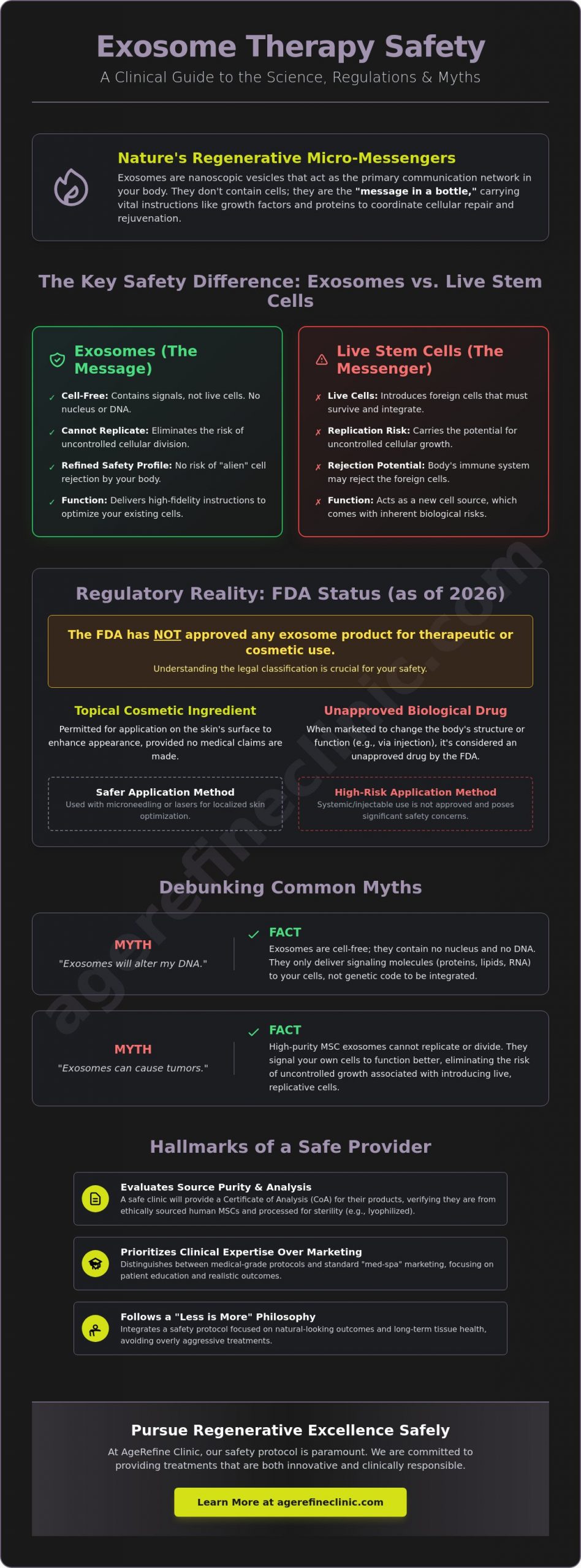
One of the first questions patients ask our clinical team is, is exosome therapy safe compared to traditional stem cell treatments? The answer lies in their cell-free nature. While stem cells are the messengers that must survive and integrate into tissue, exosomes are simply the message. Because they contain no nucleus and cannot replicate, they offer a refined safety profile that eliminates the risk of “alien” cell rejection or uncontrolled cellular division. You aren’t introducing new cells; you’re introducing the high-fidelity signals your own cells need to function at their peak.
How Exosomes Function in the Skin
Exosomes act as biological catalysts. When applied to the skin, they seek out exhausted fibroblasts and signal them to resume the production of collagen and elastin naturally. This isn’t a temporary mask. It’s a fundamental reset of the skin’s regenerative cycle. They also work to neutralize the inflammatory markers responsible for “inflamm-aging,” which is the chronic low-grade inflammation that accelerates sagging and volume loss. By regulating intercellular lipids, they strengthen the skin’s barrier and ensure your complexion remains resilient against environmental stressors.
Sourcing Matters: Where Do Professional Exosomes Come From?
Purity is the cornerstone of clinical safety. In the current aesthetic market, you may encounter exosomes derived from plants or bovine sources, yet these often lack the specific signaling compatibility required for human tissue repair. Mesenchymal stem cell (MSC) derived exosomes, typically harvested from ethically sourced umbilical cord tissue, remain the gold standard. These human-sourced vesicles possess the exact protein profiles needed to trigger meaningful biological optimization.
Determining is exosome therapy safe for your journey also depends on how the product is preserved. We prioritize exosomes that undergo lyophilization, a sophisticated freeze-drying process. This method maintains the structural integrity of the signaling proteins while ensuring the product remains sterile and potent until the moment of application. This level of pharmaceutical-grade precision is what separates a medical-grade treatment from a standard cosmetic application.
The Regulatory Reality: Is Exosome Therapy FDA Approved?
Regulatory clarity is the foundation of patient safety. While the science of extracellular vesicles is undeniably promising, the legal landscape surrounding their use is strictly defined to protect the public from unsubstantiated claims. As of June 2026, the FDA has not approved any exosome product for therapeutic or cosmetic use. A central component of determining is exosome therapy safe involves understanding the distinction between a laboratory-grade research tool and a government-sanctioned medical treatment. The agency classifies these products as biological drugs, which means they must undergo a rigorous Biologics License Application (BLA) process before they can be marketed for specific medical outcomes.
The distinction between a “drug” and a “cosmetic ingredient” often creates confusion for patients. When a substance is marketed to change the structure or function of the body, the FDA regulates it as a drug. However, many exosome products are categorized as topical cosmetic ingredients. This classification allows them to be used on the skin’s surface to enhance appearance, provided no medical claims are made. To maintain transparency, we encourage patients to review the FDA public safety notification, which outlines the current concerns regarding unapproved regenerative products.
Topical vs. Injectable: The Safety Divide
The delivery method fundamentally changes the safety conversation. Topical applications, often used in conjunction with RF microneedling for skin texture or laser rejuvenation, carry a lower risk profile because the exosomes remain localized within the dermal layers. These treatments focus on aesthetic optimization rather than systemic change. In contrast, systemic administrations like IV therapy carry significantly higher regulatory hurdles and potential risks. At AgeRefine Clinic, we prioritize localized, aesthetic applications that align with current safety standards and focus on visible skin restoration.
Navigating the ‘Unapproved’ Label
Patients often ask is exosome therapy safe when they see the “unapproved” label in a clinical setting. In modern medicine, “off-label” use refers to the professional application of a product for a purpose other than its strictly approved indication. This practice is common but requires a provider with deep clinical expertise to navigate. To bridge the gap between innovation and safety, we rely on third-party laboratory testing. These independent reports verify product purity, ensuring the absence of heavy metals or bacterial contaminants. An Investigational New Drug (IND) status is a formal designation by the FDA that allows a specific substance to be administered to human subjects within a strictly monitored clinical trial.
5 Common Myths About Exosome Safety Debunked
Clarity is the antidote to anxiety. When exploring regenerative aesthetics, patients often encounter a mixture of revolutionary promises and cautionary tales. To determine is exosome therapy safe for your personal care, we must separate biological reality from internet fiction. Misinformation often stems from a lack of distinction between different types of extracellular vesicles and their specific clinical applications.
- Myth 1: Exosomes can alter your DNA. Fact: Exosomes are specialized messengers that carry proteins and RNA to facilitate communication. They don’t contain a nucleus or the machinery required to alter your genetic blueprint or integrate into your genome.
- Myth 2: Exosomes cause tumor growth. Fact: While some research discusses the role of exosomes in cancer progression, high-purity mesenchymal stem cell (MSC) exosomes used in aesthetics are non-tumorigenic. Quality sourcing from healthy, screened donors is the essential safeguard here.
- Myth 3: You can catch a virus from exosome treatments. Fact: Professional-grade products undergo rigorous viral screening and sterilization processes. This pharmaceutical-grade oversight ensures that the vesicles are free from pathogens before they reach a clinical setting.
- Myth 4: All exosome products are created equal. Fact: There is a vast disparity in the market. Concentration and purity levels can vary by thousands of percent between brands, which is why we meticulously vet every laboratory we partner with.
- Myth 5: Exosomes are “alien” or synthetic substances. Fact: Your body produces billions of exosomes every day. They are a fundamental biological process, not a foreign chemical or a synthetic drug.
The Truth About Side Effects
Safety is often measured by the body’s immediate response. For most patients, the primary side effects are limited to localized redness or mild swelling. These are standard reactions to the delivery method, such as microneedling, rather than the exosomes themselves. You might see reports of “exosome flu” online, but this is a myth typically associated with poor-quality systemic products rather than topical aesthetic applications. Because exosomes lack cell-surface proteins that trigger immune rejection, the incidence of allergic reactions is incredibly low. We always advise patients to consult the FDA Public Safety Notification to stay informed about reported adverse events in unregulated settings.
The ‘Stem Cell’ Misconception
The term “regenerative” often leads patients to conflate exosomes with live stem cell transplants. This is a significant distinction when asking is exosome therapy safe for your journey. Because exosomes are cell-free, they carry no risk of graft-versus-host disease or unwanted cell differentiation. There is no live genetic material present in processed exosome vesicles. You receive the regenerative instructions without the biological baggage of a living cell. This makes the process both more predictable and significantly safer for sensitive aesthetic goals.
How to Identify a Safe Exosome Provider in Orange County
Choosing a partner for your regenerative journey requires more than a casual search; it demands a deep evaluation of clinical standards. In a region as saturated with aesthetic options as Orange County, the question is exosome therapy safe often depends entirely on the person holding the applicator. A clinical practice differs from a standard med-spa through its commitment to medical-grade protocols and board-certified oversight. You aren’t just looking for a technician; you’re seeking a clinician who understands the complex biological pathways of Regenerative Medicine and how they integrate with your specific health history.
Transparency is the hallmark of a safe provider. Every reputable clinic should be able to provide a Certificate of Analysis (COA) for the products they use. This document acts as a laboratory-verified receipt of purity, confirming that the exosomes are free from heavy metals, endotoxins, and bacterial contaminants. If a provider cannot or will not discuss their product sourcing with you, it’s a clear signal to look elsewhere. Excellence in this field is never accidental; it’s the result of rigorous vetting and a refusal to compromise on pharmaceutical-grade quality.
The Orange County Standard: What to Look For
Discernment is your best defense against predatory marketing. Within the local landscape, be wary of “miracle cure” language or basement-level pricing that seems too good to be true. A safe regenerative plan should always be overseen by a Board Certified Nurse Practitioner or Physician who prioritizes a “less is more” philosophy. Red flags include clinics that skip the personalized consultation phase or fail to explain the scientific rationale behind the treatment. Your journey should begin with a thorough assessment of your skin’s current state and a clear, realistic roadmap for restoration.
Evaluating the Product Brand
Integrity in manufacturing defines the safety of the outcome. We only partner with laboratories that utilize rigorous batch testing to ensure consistency across every vial. While many brands emphasize high “particle counts,” this number can be misleading if the purity of those particles is low. A high concentration of cellular debris is not the same as a high concentration of active, signaling exosomes. A closed-system manufacturing process is essential because it prevents environmental contamination and ensures the biological payload remains sterile from harvest to vial. This level of precision is why we invite you to book a consultation at AgeRefine Clinic to discuss our specific safety protocols and sourcing standards.
Finally, consider the environment and the aftermath. Sterile technique is non-negotiable for any regenerative procedure to prevent infection and ensure tissue health. A safe clinic doesn’t end the relationship when you walk out the door. They provide a structured follow-up plan to monitor your recovery and track the subtle, long-term improvements in your skin’s vitality. This methodical approach ensures that your results are both beautiful and biologically sound.
Regenerative Excellence: The AgeRefine Clinic Safety Protocol
True beauty is a reflection of internal cellular health. It’s an evolving dialogue between advanced biological science and the individual self. At AgeRefine Clinic, Helen Liu, NP, leads this conversation with a “less is more” philosophy. This approach ensures that every regenerative intervention we perform respects your natural architecture while stimulating meaningful repair. We don’t just ask is exosome therapy safe; we ask how it can be applied with the highest level of clinical restraint to achieve your specific longevity goals. Our focus remains on long-term vitality rather than the fleeting results of aggressive, quick-fix marketing.
Our commitment to safety is grounded in a multi-step screening process that begins long before a product reaches our Irvine office. We meticulously vet every manufacturer’s batch records and third-party laboratory reports. We only select regenerative products that meet our internal benchmarks for purity and precise particle concentration. This pharmaceutical-grade oversight allows us to provide a level of care that prioritizes your biological integrity above all else. We believe that professional consultation is a partnership built on transparency and clinical authority.
We don’t view exosomes as a standalone solution, but as a critical component of a comprehensive regenerative ecosystem. By integrating these messengers with established therapies like XERF or RF microneedling for skin texture, we create a synergistic effect. The mechanical stimulation of microneedling opens the pathways, while the exosomes provide the necessary signaling to optimize the healing response. This dual-layered approach is why patients seeking the highest standards often ask is exosome therapy safe within our specific clinical practice; they find peace of mind in our methodical, evidence-based protocols.
Your Safety Journey in Irvine
Your experience begins with a sophisticated skin analysis to assess your current tissue integrity. We customize the exosome concentration based on your unique needs, ensuring the treatment is as personalized as your own genetic code. We also explore the synergy between Peptide Therapy and cellular signaling to support total body optimization. From the initial consultation to post-treatment biostimulation monitoring, every step is designed to empower your journey toward natural restoration.
Experience Sophisticated Restoration
Our Irvine patients trust us because we value authenticity over artifice. We provide a sanctuary where sensitive aesthetic concerns are met with empathy and rigorous medical expertise. You deserve results that look like you, only more rested and biologically vibrant. This is the AgeRefine standard of excellence: a safe, female-led environment dedicated to your long-term well-being. Schedule your expert consultation at AgeRefine Clinic today to begin your personalized restoration plan.
Embracing the Future of Biological Restoration
Beauty is an enduring journey of cellular health and personalized care. While the technology is undeniably revolutionary, the final answer to is exosome therapy safe depends entirely on the integrity of your provider and the purity of the biological source. We’ve explored the regulatory landscape of 2026 and debunked the common myths that often cloud this innovative field; clarifying that safety is a variable of clinical expertise rather than just the treatment itself.
At AgeRefine Clinic, our practice is led by Board Certified NP Helen Liu. We specialize in non-invasive regenerative medicine that respects your unique biology. Every product we select undergoes rigorous third-party lab testing to ensure it meets our elite standards of excellence. You deserve a guide who values your long-term health journey as much as your aesthetic results. It’s time to move beyond temporary fixes and toward true biological optimization. Book Your Clinical Exosome Consultation in Irvine to begin your partnership with a team that prioritizes your safety and natural vitality.
Frequently Asked Questions
Is exosome therapy safer than stem cell therapy?
Exosomes are generally considered to have a superior safety profile for aesthetic use because they are cell-free. Unlike stem cells, they don’t contain a nucleus and cannot replicate or differentiate into unwanted tissue types. This elimination of live genetic material removes the risk of graft-versus-host disease. You’re receiving the healing signals without the biological risks associated with living cell transplants, making the results more predictable and controlled.
What are the most common side effects of topical exosome treatment?
The most common side effects are localized and temporary, often lasting only 24 to 48 hours. Patients typically experience mild redness, slight swelling, or a feeling of warmth in the treated area. It’s important to distinguish these as reactions to the delivery method, such as RF microneedling, rather than the exosomes themselves. These manageable symptoms are signs of the body’s natural inflammatory response initiating the repair process.
Can exosomes cause an immune rejection or allergic reaction?
Immune rejection is extremely rare because exosomes lack the surface proteins that typically trigger a defensive response. Because they don’t carry the major histocompatibility complex (MHC) markers found on whole cells, your body doesn’t recognize them as a foreign threat. This makes them an ideal option for patients concerned about sensitivities. We prioritize high-purity mesenchymal stem cell (MSC) exosomes to ensure the highest degree of biological compatibility.
How do I know if the exosome product being used is high quality?
Evaluating the Certificate of Analysis (COA) is the most reliable way to verify product quality. A high-quality exosome product must be human-sourced from healthy, screened donors and undergo rigorous batch testing for purity and concentration. Don’t be swayed by marketing numbers alone. Look for a provider who is transparent about their sourcing and can prove the absence of heavy metals, bacterial contaminants, or cellular debris in their vials.
Is exosome therapy legal in the United States in 2026?
The legality of exosome therapy is complex and continues to evolve through 2026. While the FDA hasn’t approved any exosome product as a drug, they are frequently used off-label in clinical settings or as topical cosmetic ingredients. In California, medical professionals must strictly adhere to state board standards. Determining is exosome therapy safe and legal for you depends on the provider’s adherence to these specific regulatory and sterile protocols.
What happens if exosomes are injected incorrectly?
Incorrect administration can lead to localized complications such as infection, inflammation, or the formation of granulomas. Because these are biological products, sterile technique and anatomical knowledge are non-negotiable. If a product is injected into an inappropriate tissue plane or is contaminated during handling, it can cause adverse reactions. This highlights why choosing a board-certified clinician over a standard technician is vital for your aesthetic safety.
Are there any long-term risks associated with exosome therapy?
Long-term data is still being gathered through ongoing clinical trials worldwide. Current research into mesenchymal stem cell exosomes indicates they are non-tumorigenic and don’t pose the same long-term risks as live stem cell therapies. However, because the field is still maturing, we maintain a “less is more” philosophy. We monitor our patients’ tissue health over time to ensure that cellular optimization remains consistent and safe throughout their aging journey.
Can I get exosome therapy if I have an autoimmune condition?
Patients with autoimmune conditions require a personalized clinical evaluation before proceeding with regenerative treatments. While exosomes are known for their immunomodulatory properties, their effect on a hyper-reactive immune system must be carefully managed. We assess your specific condition and current medications to determine is exosome therapy safe for your unique health profile. Your long-term well-being is always our primary priority during these sensitive health transitions.
Leave a Reply