What if years of Orange County sunshine show up not only as stubborn brown spots, but also as thinner, less elastic skin? If beach days have left uneven pigmentation or crepey texture on your face and neck, it makes sense to look for a plan that addresses your priorities without assuming aggressive treatment or weeks of downtime are the only path. The right skin rejuvenation for sun damage OC plan starts by identifying whether tone, texture, firmness, or several concerns matter most to you.
At AgeRefine Clinic in Irvine, Board Certified Nurse Practitioner Helen Liu leads a personalized approach to aesthetic care. This guide explains how to compare options such as laser skin rejuvenation, RF microneedling, XERF, and regenerative treatments, and what to ask about their intended use, comfort, and recovery. You’ll also learn how to prepare for a consultation and discuss ongoing care that fits an Orange County lifestyle. The goal is informed, thoughtful restoration, not a changed appearance.
Key Takeaways
- Understand why Orange County sun exposure can affect both visible pigmentation and skin texture, then decide which concerns matter most to you.
- Learn how regenerative options, including exosome injections and PRP/PRF, may be discussed in skin care and what to ask a provider about their role in an individualized plan.
- Compare laser skin rejuvenation and RF microneedling with other services, such as XERF and ONDA Pro, by matching each option to its intended purpose and your goals.
- Explore how skin rejuvenation for sun damage OC involves more than an in-office procedure, including practical sun protection and a conversation about wellness services such as peptide and IV therapy.
- Prepare for a Board Certified Nurse Practitioner-led consultation at AgeRefine Clinic in Irvine by listing your priorities, questions, and downtime preferences.
Restoring Vitality: The Impact of the Orange County Climate on Skin Integrity
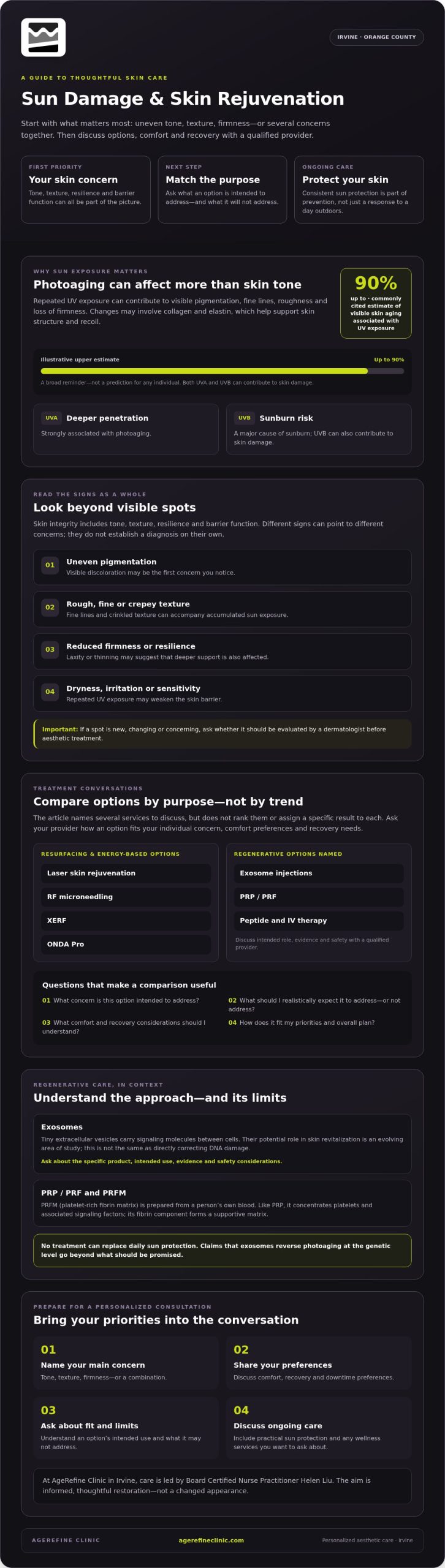
Sun damage is more than a collection of brown spots. Photoaging describes changes associated with repeated ultraviolet (UV) exposure, including uneven pigmentation, fine lines, roughness, and loss of firmness. Ongoing UV exposure can contribute to changes in the structures that help skin stay resilient. The Science of photoaging helps explain why visible signs may involve more than the surface.
Orange County’s outdoor lifestyle can mean regular sun exposure during beach visits, walks, and everyday errands. UV radiation can contribute to changes in collagen and elastin, proteins that support skin’s structure and recoil. Over time, skin may look less supple, even when dark spots are the concern that first catches your eye.
The 90% Rule: Why UV Is a Primary Driver of Aging
A commonly cited estimate suggests that UV exposure accounts for up to 90% of visible skin aging. Treat that figure as a broad reminder, not a prediction of what will happen to every person. UVA rays penetrate more deeply and are strongly associated with photoaging; UVB rays are a major cause of sunburn. Both can contribute to skin damage. In a sunny climate, consistent sun protection is part of prevention, not just a response to a day outdoors.
Signs of Compromised Skin Integrity
Look beyond spots. Yellowish, thickened areas from accumulated sun exposure, known clinically as solar elastosis, and fine, crinkled or crepey texture can point to structural changes. Pigmentation is visible on the surface, while laxity and thinning suggest that deeper support may also be affected. Skin integrity means considering tone, texture, resilience, and barrier function together.
Repeated UV exposure may weaken the skin barrier, leaving skin more prone to dryness, irritation, or sensitivity. These signs don’t establish a diagnosis on their own, so a qualified provider can help assess what’s happening and what care may be appropriate. If a spot is new, changing, or otherwise concerning, ask whether it should be evaluated by a dermatologist before aesthetic treatment.
For skin rejuvenation for sun damage OC, this distinction matters. A plan focused only on discoloration may not address texture or firmness. Start by identifying your main concern, then ask which treatment is intended to address it and what it will not address. The goal is healthier-looking skin with more even tone and improved texture, while respecting its natural character.
Beyond the Surface: The Science of Regenerative Skin Rejuvenation
Traditional resurfacing approaches create a controlled response so the skin can repair itself. Regenerative aesthetics explores ways to support the body’s signaling and healing processes, rather than relying on resurfacing alone. That doesn’t mean one method replaces another. As medical guidance on treatments for sun damage illustrates, care can involve different approaches depending on the concern. The goal is to match the option to the skin and the person, not to follow a trend.
For people considering skin rejuvenation for sun damage OC, this broader perspective can be useful. Pigmentation, texture, and laxity may call for different strategies, and regenerative options are best discussed with a qualified provider as part of an individualized plan. AgeRefine Clinic in Irvine offers regenerative medicine, including exosome injections and PRP/PRF for the face. Learn more about the era of regenerative aesthetics.
Exosome Skin Therapy: Cellular Signaling for Sun Repair
Exosomes are tiny extracellular vesicles that cells use to carry signaling molecules to other cells. In regenerative medicine, they’re studied for how their contents may influence cellular communication and repair responses. This is not the same as directly correcting DNA damage, and claims that exosomes reverse photoaging at the genetic level go beyond what should be promised. Their potential role in skin revitalization is an evolving area, so ask a provider about the specific product, its intended use, evidence, and safety considerations. No treatment can replace daily sun protection.
PRFM: A Fibrin-Based Approach
Platelet-rich fibrin matrix (PRFM) is prepared from a person’s own blood. Like platelet-rich plasma (PRP), it concentrates platelets and associated signaling factors; the fibrin component forms a supportive matrix. This structure may hold platelets at the treatment site and allow growth factors to be released over time, although individual responses and outcomes vary. PRFM is not a guaranteed route to long-term collagen production, and suitability depends on personal health and treatment goals. Explore the details of platelet-rich fibrin matrix.
Regenerative options can complement, rather than automatically replace, energy-based treatments. During a consultation, ask which concern each option is intended to address, what evidence supports its use, and what realistic outcomes may look like. To learn about AgeRefine Clinic’s approach, visit the Irvine aesthetics clinic.
Precision Technologies for Sun Damage: ONDA Pro and XERF vs. Traditional Lasers
Different skin concerns call for different approaches. Ablative lasers remove layers of skin to prompt renewal, which may be useful for selected concerns but can involve more recovery than non-ablative approaches. Other laser treatments target specific concerns without removing the skin’s surface. Yale Medicine’s overview of Photoaging (Sun Damage) describes lasers among the treatment options, but no single technology is right for everyone. Pigment, texture, skin type, medical history, and tolerance for downtime all matter.
Laser skin rejuvenation and RF microneedling are among the skin services AgeRefine Clinic offers. XERF is offered for skin revitalization, while ONDA Pro is a non-invasive body-contouring service, not a laser treatment for sun spots. These options have different purposes, so they should not be treated as interchangeable. A provider can help determine which services, if any, fit your goals for skin rejuvenation for sun damage OC.
ONDA Pro: Microwave Energy for Skin Tightening
ONDA Pro uses microwave energy delivered through its Coolwaves technology. At AgeRefine Clinic, it is offered for non-invasive body contouring. It is not a direct substitute for a laser skin treatment intended to address pigmentation or surface texture. If you’re considering ONDA Pro, ask what body-contouring concern it is intended to address, whether it fits your goals, and what recovery may look like.
When comparing treatments, be specific about the area and concern you want to address. Ask what sensations to expect, what the treatment is designed to do, and what aftercare may involve. The ONDA Pro Irvine guide offers more information about the technology.
XERF and Bio-Revitalization: Restoring Skin Density
XERF is a non-invasive option offered at AgeRefine Clinic for skin revitalization. It differs from an ablative laser, which removes outer layers of skin. If your concern is crepey texture or fine lines, ask a provider whether XERF fits your needs, what results are realistic, and how it compares with other options offered by the clinic, such as laser skin rejuvenation or RF microneedling. “Minimal downtime” shouldn’t be treated as a universal promise; your experience depends on the treatment plan and individual response.
Precision means choosing with restraint. Ask how a proposed treatment relates to your specific concern, whether it is intended to address tone, texture, or firmness, and how it fits alongside other options. Explore the clinic’s explanation of bio-revitalization treatment, or learn more about AgeRefine Clinic at the Irvine aesthetics clinic.
A Holistic Protocol: Integrating Peptides and IV Therapy for Sun Recovery
Skin care doesn’t happen in isolation. Overall health can affect skin, but that doesn’t mean an IV or peptide protocol can undo UV injury or replace sun protection. A thoughtful inside-out approach considers nutrition, hydration, sleep, skin care, and relevant medical factors alongside aesthetic treatments. For skin rejuvenation for sun damage OC, wellness services are best viewed as potential parts of an individualized plan, not guaranteed shortcuts to repair.
AgeRefine Clinic offers Peptide Therapy and IV Therapy. Whether either is appropriate depends on a person’s health history, goals, and the specific treatment proposed. Ask what the therapy is intended to support, what evidence applies to that use, and how progress will be evaluated. The clinic’s guide to the architecture of vitality explores peptide therapy in a broader wellness context.
Peptides for Skin Repair: GHK-Cu and Beyond
Peptides are short chains of amino acids, and different peptides have different proposed functions. GHK-Cu, a copper-binding peptide, is often discussed in skin-care research for its possible relationship to repair and collagen-related processes. That doesn’t establish that peptide injections repair sun-damaged DNA or reverse photoaging. Evidence and appropriate use depend on the specific peptide and route of administration. Ask a qualified provider which compound is being considered, its intended purpose, and what is known about its risks and benefits.
Peptide Therapy may be considered in a broader wellness plan, but “biohacking” shouldn’t mean bypassing medical assessment. A clinician can help distinguish a realistic, evidence-informed goal from a claim that overpromises. AgeRefine’s approach can incorporate wellness considerations alongside aesthetic care when appropriate.
IV Therapy: Hydration and Skin Support
Maintaining adequate hydration supports normal body function, but IV fluids shouldn’t be described as directly hydrating the dermis or treating sun damage. IV Therapy may have a role in specific circumstances; it isn’t a substitute for drinking fluids or routine skin care. Similarly, Vitamin C and glutathione are associated with antioxidant activity, but don’t assume an IV formula contains either nutrient or that it will reliably brighten skin. Ask about ingredients, intended use, possible risks, and whether IV treatment is suitable for you.
A maintenance plan doesn’t need an automatic monthly appointment. Its timing should reflect your goals, health considerations, and a provider’s recommendations. For a personalized discussion of Peptide Therapy or IV Therapy, explore AgeRefine Clinic’s wellness services and ask how they may fit alongside your skin-care plan.
Your Consultation at AgeRefine Clinic: Tailored Rejuvenation in Irvine
Good aesthetic care starts with listening. At AgeRefine Clinic in Irvine, Board Certified Nurse Practitioner Helen Liu leads a personalized approach that considers your skin concerns, health context, comfort level, and desired outcome. Rather than defaulting to the most intensive option, the aim is a thoughtful plan with natural-looking results and room to adjust over time.
That matters for skin rejuvenation for sun damage OC, since spots, uneven texture, and reduced firmness may not respond to the same approach. A consultation is an opportunity to explain what bothers you, discuss your priorities and downtime preferences, and ask questions before deciding whether a treatment is appropriate. Read more about aesthetic medicine in Irvine, CA.
The Empathetic Expert Approach
Aesthetic decisions are personal. A consultation can make space for an open conversation about changing skin, confidence, and the results that still feel like you. The focus is not a quick fix or a dramatic transformation, but a plan that respects your preferences and can be revisited over time. Considering advanced options carefully means understanding their purpose and recommending only what aligns with your goals.
AgeRefine’s offerings include laser skin rejuvenation, RF microneedling, regenerative treatments, and wellness services such as Peptide Therapy and IV Therapy. Not every option belongs in every plan. A provider can help distinguish treatments aimed at skin concerns from those intended for other purposes, then discuss realistic expectations, potential risks, and recovery considerations.
Preparing for a Personalized Consultation
There’s no need to arrive with a treatment already chosen. Before your visit, note the changes you notice most, any prior procedures or skin reactions, your everyday sun exposure, and how much downtime you can accommodate. Bring questions about why a treatment is being considered, expected sensations, aftercare, and how progress will be reviewed. Share relevant health information so your provider can discuss options in light of your individual circumstances.
A “less is more” roadmap may prioritize one concern first, then reassess before considering additional modalities. That measured pace can help keep the plan aligned with your natural features and busy Orange County routine. To discuss your goals with the Irvine team, contact AgeRefine Clinic about a personalized consultation.
Skin Rejuvenation for Sun Damage OC: Choose a Thoughtful Path to Healthier-Looking Skin
Sun damage can affect more than skin tone. A practical first step is to separate your concerns into pigmentation, texture, firmness, or a combination, then ask which options are designed to address each one. Precision technologies and regenerative services may each play a role, but no single treatment is right for everyone, and consistent sun protection remains essential.
For skin rejuvenation for sun damage OC, AgeRefine Clinic offers laser skin rejuvenation, XERF for skin revitalization, and regenerative options in a personalized aesthetic practice in Irvine. ONDA Pro is available for non-invasive body contouring, while other services address different goals. The guiding philosophy is measured: focus on your priorities, compare options carefully, and build a plan that respects your natural features and lifestyle.
If you’re ready to discuss what may suit your skin, Schedule Your Private Consultation at AgeRefine Clinic. A thoughtful conversation can be a reassuring first step toward feeling more confident in your skin.
Frequently Asked Questions
What is the best treatment for sun spots in Orange County?
There isn’t one best treatment for every sun spot; the right option depends on the spot’s cause, your skin, and your goals. A qualified provider can assess whether laser skin rejuvenation may be appropriate or whether a spot should be evaluated by a dermatologist before aesthetic treatment. For skin rejuvenation for sun damage OC, discuss pigmentation alongside texture and firmness so your plan reflects your priorities rather than assuming one treatment will resolve every concern.
How many sessions of exosome therapy are needed for sun damage?
There’s no established session count that applies to everyone, and outcomes for exosome therapy can’t be guaranteed. The number, timing, and suitability of treatments depend on the specific product, its intended use, your health history, and the evidence available. Before proceeding, ask the provider what the treatment is intended to address, what results are realistic, and what risks or alternatives to consider. A personalized assessment is more useful than relying on a fixed session promise.
Is ONDA Pro better than traditional laser for skin tightening?
ONDA Pro and lasers use different technologies and aren’t interchangeable. AgeRefine offers ONDA Pro for non-invasive body contouring, while laser skin rejuvenation may be considered for certain skin concerns. They are not direct alternatives for the same goal, so clarify whether your priority is body contouring, pigmentation, texture, or firmness. Ask a provider to explain the purpose, limitations, and expected recovery of each option before choosing.
Can regenerative medicine really reverse years of sun exposure?
Regenerative medicine may be discussed in relation to aesthetic goals, but it can’t promise to erase years of sun exposure or completely reverse photoaging. Treatments such as exosome injections or PRP/PRF may be considered as part of an individualized plan, with appropriate attention to evidence, risks, and realistic outcomes. A clinician can help you weigh them alongside other options. Ongoing sun protection remains important, since treatment doesn’t prevent future UV-related skin changes.
What is the downtime for skin rejuvenation treatments at AgeRefine?
Downtime depends on the specific treatment, the area addressed, and your individual response. AgeRefine offers options including laser skin rejuvenation, RF microneedling, and XERF, but recovery expectations can differ by modality and treatment plan. Ask the clinic what to expect after the specific procedure being considered, including possible redness, sensitivity, activity restrictions, and aftercare. Don’t assume that “non-invasive” means there will be no recovery period.
How does peptide therapy help with sun-damaged skin?
Peptide Therapy is offered at AgeRefine as a wellness service, but it shouldn’t be presented as a proven way to repair sun-damaged DNA or reverse photoaging. Peptides vary, and evidence depends on the specific compound and how it’s used. Ask the provider about the intended purpose, supporting evidence, potential risks, and whether it suits your health history. Peptide therapy doesn’t replace sun protection or established skin treatments.
Is skin rejuvenation for sun damage safe for all skin types?
No treatment is automatically suitable for every skin type or person. Skin tone, sensitivity, medical history, medications, and previous reactions can influence which options are appropriate and how the skin may respond. Before treatment, discuss these details with a qualified provider and ask about risks such as irritation or pigment changes, as well as alternatives. A careful assessment helps guide a plan for Orange County patients seeking individualized care.
How do I maintain my results in the OC sun?
Protecting your skin from further UV exposure is central to maintaining results. Use broad-spectrum sunscreen as directed, seek shade, and wear protective clothing when outdoors. Follow the aftercare plan provided for your treatment, and ask how to adjust your routine if sensitivity develops. In Orange County, where outdoor activities are part of daily life, practical sun-protection habits and provider follow-up can help support ongoing skin care.