Could a treatment designed to improve skin texture feel clear and manageable before you decide whether it’s right for you? If you’re considering RF microneedling Irvine CA, it’s natural to have questions about what the treatment does, how it compares with standard microneedling, and what recovery may involve.
RF microneedling uses fine needles to deliver radiofrequency energy beneath the skin, where controlled heat can support collagen remodeling. It may be considered for concerns such as uneven texture, but results vary, and it isn’t suitable for everyone. Understanding the treatment’s purpose and limitations can help you decide whether it fits your goals.
This guide explains how RF microneedling works, who may benefit, and what to discuss about comfort, downtime, risks, and realistic expectations. You’ll also learn how it differs from other skin treatments. At AgeRefine Clinic in Irvine, board-certified nurse practitioner Helen Liu leads a personalized approach that starts with your skin concerns and goals. An assessment can help you understand suitability and possible next steps.
Key Takeaways
- RF microneedling Irvine CA may be worth exploring for skin texture concerns, but understanding its limits helps set realistic expectations.
- Learn how microneedling and radiofrequency work together, and why collagen-related changes aren’t guaranteed.
- Compare RF microneedling with standard microneedling, laser rejuvenation, and skincare based on your goals and each approach’s caveats.
- Prepare for a personalized consultation by organizing your skin concerns, health history, medications, and questions about recovery and risks.
- AgeRefine Clinic offers RF microneedling for skin texture, led by Helen Liu, a board-certified nurse practitioner specializing in aesthetic medicine.
What RF Microneedling in Irvine Can Address, and What It Cannot
Wanting smoother-feeling or more even-looking skin doesn’t mean you need to have a diagnosis in mind. “Skin texture” is a broad way to describe what you notice, whether it’s a rough feel, visible unevenness, or a change that stands out in certain lighting. Describe what you see and feel, where you notice it, and what kind of improvement would matter to you. These details give the clinician a more useful starting point than a general request for “better skin.”
In brief: RF microneedling combines tiny needles with radiofrequency energy, while microneedling alone uses needles without that added energy.
The needles create controlled openings in the skin, and radiofrequency energy adds heat to the tissue. These elements distinguish RF microneedling from conventional microneedling, but the technology itself doesn’t establish whether treatment is appropriate for a particular person. A clinical assessment considers the skin, relevant medical history, and the outcome you hope to achieve.
For someone researching RF microneedling Irvine CA, it helps to treat the consultation as a conversation about fit, not a promise of a particular result. A clinician can clarify whether the concern aligns with a skin-texture goal, discuss what changes may be realistic, and explain whether another approach could be a better match. Suitability and response vary from person to person.
Which skin-texture concerns may prompt an RF microneedling consultation?
A person might seek guidance because their skin feels less smooth than they’d like or looks uneven to them. Those observations are useful starting points, not diagnoses or proof that RF microneedling is indicated. During an assessment, the clinician reviews the skin and medical history, listens to the person’s priorities, and discusses the result they hope for. The aim is a considered recommendation, not an assumption that one treatment suits every concern.
What RF microneedling is not designed to promise
RF microneedling should not be framed as an instant change or a surgical transformation. It’s a skin-quality treatment, and any visible response can differ between individuals. A consultation can help set realistic expectations, explain relevant considerations, and determine whether RF microneedling or another approach better fits the concern.
It’s also reasonable to define what “improvement” would mean in your case. Is the priority how skin feels, how it appears in everyday light, or a specific area? Clear goals keep the discussion grounded and help distinguish a gradual skin-texture aim from changes that may call for a different type of care.
No single description of texture can predict candidacy or outcome. A personalized clinical assessment gives context to your concerns and helps you weigh possible benefits against limitations before making a decision.
How RF Microneedling Works: Needles, Radiofrequency, and Collagen Response
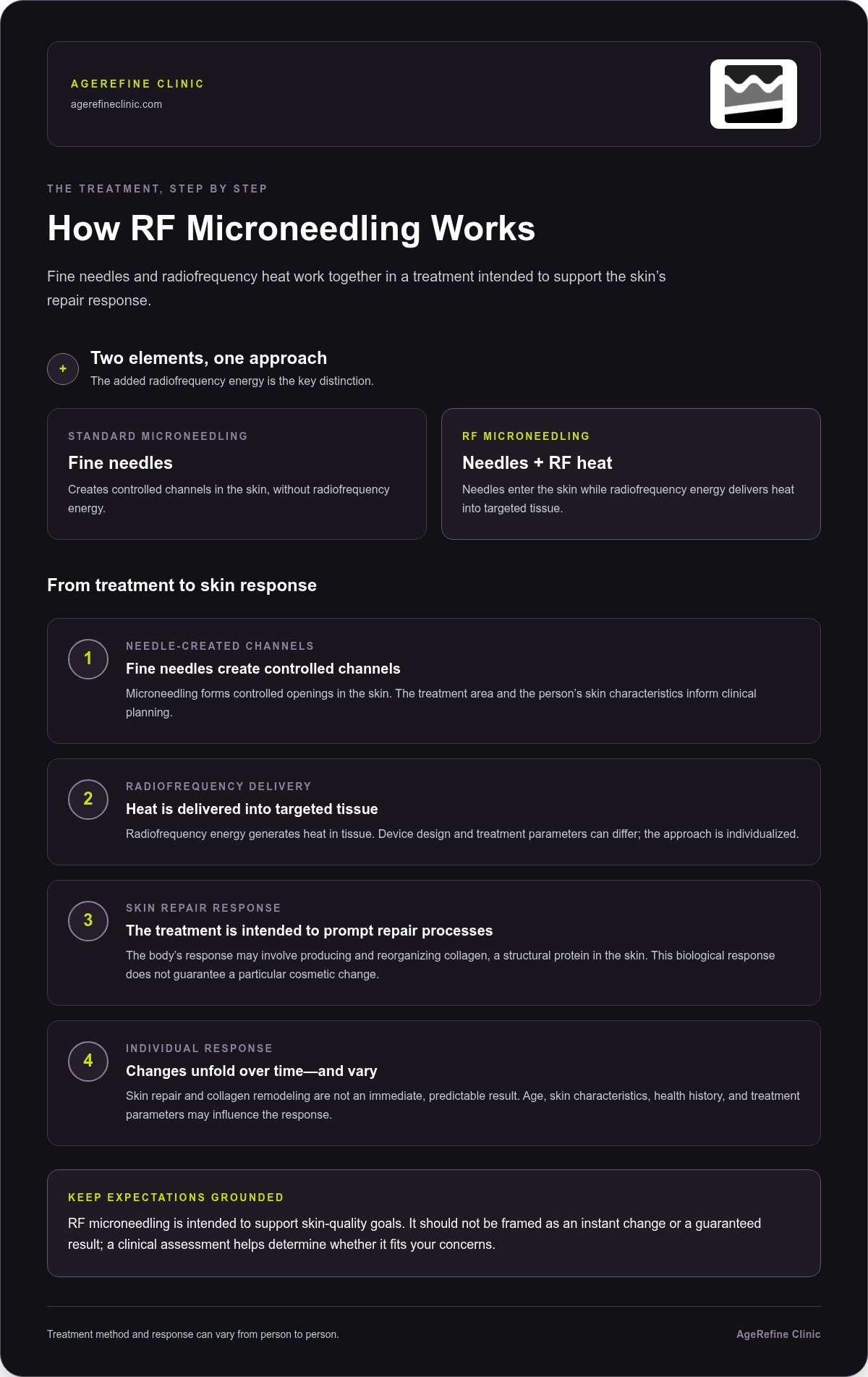
RF microneedling combines two elements: microneedling, which uses fine needles to create controlled channels in the skin, and radiofrequency, which delivers heat into targeted tissue. Together, these create a treatment approach intended to prompt a skin repair response. The precise method depends on the device and individualized treatment parameters.
In brief: RF microneedling pairs needle-created channels with radiofrequency heat to encourage the skin’s repair processes, including collagen remodeling.
Collagen is a structural protein in the skin. After a controlled treatment, the body’s response may include processes involved in producing and reorganizing collagen. This is a biological response, not a switch that guarantees a particular cosmetic change. The treatment is intended to support skin-quality goals, while the degree of visible response varies.
How microneedling and radiofrequency work together
Microneedling uses fine needles to create controlled channels. Radiofrequency is energy that generates heat in tissue. In RF microneedling, needles enter the skin while radiofrequency energy is delivered into targeted tissue. This differs from microneedling alone, which uses needles without radiofrequency. The combination doesn’t mean every device or treatment plan works identically.
Device design and treatment choices matter. Depth and energy parameters may differ, and a clinician considers them in relation to the treatment area and the individual’s skin. Those details aren’t interchangeable settings to choose based on a trend or another person’s experience. A clinical assessment guides the plan; no particular depth, temperature, or device specification should be assumed for every treatment.
Why skin response and timelines vary
The skin’s repair and collagen-remodeling processes unfold over time rather than producing an immediate, predictable result. Age, skin characteristics, health history, and treatment parameters may all influence response. A fixed timeline or promised before-and-after change can’t accurately describe everyone’s experience. A clinician can explain what to monitor and how expectations fit your individual circumstances.
For example, two people may have similar texture concerns but different skin characteristics or health histories. Their assessments and treatment considerations may therefore differ. Even when a treatment is appropriate, the amount and visibility of change can vary. The aim is an informed plan, not a guaranteed outcome.
If you’re exploring RF microneedling Irvine CA, useful questions include how the treatment’s mechanism relates to your goals, which factors shape the plan, and what kind of change is realistic for you. A consultation can connect the general science with your own skin and help determine whether this approach makes sense.
At AgeRefine Clinic, you can discuss RF microneedling for skin texture in relation to your concerns and expectations.
RF Microneedling Compared With Other Skin Treatments: Choosing by Goal
Different skin treatments use different methods, so comparing them by intensity alone can be misleading. A more useful question is which approach fits your concern, skin characteristics, and comfort with treatment and recovery. RF microneedling, conventional microneedling, laser skin rejuvenation, and non-energy-based skincare aren’t interchangeable, and none is automatically the best choice for everyone.
| Treatment category | General approach | Useful discussion | Key caveat |
|---|---|---|---|
| RF microneedling | Combines fine needles with radiofrequency energy delivered into targeted tissue. | Whether a combined needle-and-energy approach aligns with the skin goal. | Device and treatment parameters vary; individual response isn’t guaranteed. |
| Conventional microneedling | Uses fine needles without radiofrequency energy. | Whether microneedling alone is appropriate for the concern. | It differs from RF microneedling, even though both use needles. |
| Laser skin rejuvenation | Uses laser energy to address selected skin concerns. | How the specific device and concern inform a laser-based approach. | Laser procedures differ from needling and aren’t interchangeable with it. |
| Non-energy-based skincare | Uses topical products as part of a skin-care routine. | Whether consistent topical care suits the goal or complements a procedure. | It doesn’t use needles or device-delivered energy. |
RF microneedling versus conventional microneedling
Both approaches use microneedles, but RF microneedling adds radiofrequency energy. That difference describes the method, not a universal advantage. The right discussion depends on the person’s skin assessment, desired outcome, and clinical judgment. If you’re comparing options, ask what role the added energy may serve for your specific concern and how the clinician will determine whether either approach is suitable.
RF microneedling versus laser skin rejuvenation
Laser skin rejuvenation and RF microneedling use distinct technologies. A comparison should account for the particular device, the concern being considered, skin characteristics, and the relevant risk profile. The label “laser” covers different approaches, just as RF microneedling plans can differ. Broader bio-revitalization treatment and skin integrity context can also help frame skin goals beyond a single device.
More intensity doesn’t necessarily mean better or faster results. Increasing energy or choosing a more involved procedure without a clear reason may not serve your goals. Treatment selection and parameters call for clinical judgment, not a contest to choose the strongest option.
For a consultation about RF microneedling Irvine CA, describe what you want to change, what you’ve already tried, and what recovery considerations matter to you. These details give the clinician a practical basis for comparing options and discussing an individualized plan. AgeRefine Clinic also offers laser skin rejuvenation, another option to discuss when comparing approaches to skin concerns.
Preparing for RF Microneedling in Irvine: Consultation, Safety, and Recovery
A thoughtful consultation makes room for more than the treatment itself. It helps the clinician understand your goals and health context, assess whether RF microneedling is suitable, and discuss relevant risks and aftercare before you decide. Bring questions, too. You don’t need clinical terms to explain what you’ve noticed or what you hope might change.
What to discuss during an Irvine consultation
Share a complete picture, including medical history, current medications, prior procedures, and skin sensitivities. Be specific about your goals: describe the area or texture change that concerns you and what a satisfactory result would look like in everyday life. Clinical assessment helps determine whether treatment may be appropriate and how the plan should be individualized.
A simple preparation framework can help you organize the discussion:
- Goals: Describe what you hope to address and how you would recognize a meaningful, realistic change.
- Health history: Share relevant medical conditions and other health information with the clinician.
- Medications: Bring an accurate list of prescription and nonprescription medications. Don’t stop or change a prescribed medication unless the clinician who manages it advises you to.
- Skin concerns: Mention sensitivities, current concerns, and previous skin procedures or treatments.
- Questions: Ask about suitability, possible risks, expected recovery considerations, and whom to contact if you have concerns afterward.
These details aren’t a checklist for self-diagnosing candidacy. They give the clinician context to assess your situation and explain options in terms you can understand. Raise any health or skin concern before treatment planning proceeds.
What to understand about recovery and safety
Recovery and risk discussions should be specific to the treatment plan and your circumstances. Don’t rely on a universal downtime estimate or someone else’s experience as a forecast for your own. The treating clinician should explain relevant risks, any precautions that apply to you, and what aftercare to follow. Pre- and post-treatment instructions should be individualized by the treating clinician.
Before the appointment, clarify how to prepare and which instructions take priority if they differ from general information you’ve read. After treatment, follow the clinician’s guidance and raise concerns with the treating clinician rather than trying to interpret an unexpected reaction alone. This keeps the conversation grounded in your care and the details of your treatment.
If you’re considering RF microneedling Irvine CA, AgeRefine Clinic offers a personalized consultation focused on skin concerns, suitability, and realistic expectations. Discuss RF microneedling with AgeRefine Clinic and bring your goals and questions to the conversation.
Personalized RF Microneedling at AgeRefine Clinic in Irvine
Skin goals are personal, and a useful treatment discussion should be, too. AgeRefine Clinic is an Irvine practice offering RF microneedling for skin texture. The clinic is founded and led by Helen Liu, a board-certified nurse practitioner specializing in aesthetic medicine. This clinical leadership supports an approach centered on understanding the person behind the concern, rather than applying a preset recommendation.
RF microneedling Irvine CA may be one option to discuss if you’re exploring ways to address skin texture. Whether it aligns with your goals depends on an individualized assessment. A conversation can clarify what you’ve noticed, what you hope to change, and what a realistic treatment goal might look like. No particular result, device setting, or treatment schedule should be assumed before that discussion.
A consultation grounded in clinical assessment
A respectful consultation makes space for your priorities and the context that may shape treatment planning. Describe what concerns you about your skin, where you notice it, and what “better” would mean in practical terms. Your goals, medical history, and the clinician’s assessment of your skin all inform whether RF microneedling may be appropriate and how a plan should be considered.
It can help to be more specific than a general wish for smoother skin. For instance, explain that a texture change is most noticeable in certain lighting, or that you’re looking for a gradual skin-quality approach rather than a dramatic transformation. These details help make expectations more specific without presuming that treatment will deliver a particular outcome. You can also ask how the clinician weighs your priorities against relevant safety considerations.
AgeRefine Clinic’s work sits within a broader aesthetic-care context. Learning about aesthetic medicine in Irvine, CA can help you place a skin-texture goal among different approaches to aesthetic care, without assuming that every option is right for every person.
Taking the next step with AgeRefine Clinic
Before deciding, bring the questions that matter to you. You might ask how candidacy is assessed, which risks are relevant to your circumstances, what recovery guidance would apply, and how the clinician defines a realistic goal. Include concerns about medications, prior procedures, or skin sensitivities so they can be considered as part of the assessment.
A consultation isn’t a commitment to proceed. It’s an opportunity to understand the reasoning behind a recommendation, consider whether it fits your priorities, and make an informed decision at your own pace. If RF microneedling isn’t the best match for your concern, the discussion can clarify whether another approach deserves consideration.
Explore the clinic’s information about RF microneedling at AgeRefine Clinic and learn how the treatment may relate to your skin goals.
Take the Next Step at Your Own Pace
A thoughtful next step can be as simple as getting clear on what you want to understand before making a decision. Consider what you hope to feel or see differently, what questions remain, and what would help you feel comfortable with a treatment plan. That clarity can make a consultation more useful, whether you’re exploring RF microneedling Irvine CA now or still weighing your options in Orange County.
At AgeRefine Clinic in Irvine, a conversation about skin texture can help you consider whether RF microneedling fits your personal goals. Helen Liu, the clinic’s founder and leader, is a board-certified nurse practitioner specializing in aesthetic medicine. The focus is on an informed discussion, not pressure to proceed.
Schedule a personalized RF microneedling consultation at AgeRefine Clinic to discuss your skin goals, suitability, and expectations.
Frequently Asked Questions
What is RF microneedling?
RF microneedling is a skin treatment that combines microneedling with radiofrequency energy. The needles create controlled channels, while the energy delivers heat to targeted tissue. In practical terms, it combines two treatment components rather than relying on needles alone. The device and treatment plan affect how it’s performed, so a clinician can explain the approach being considered and how it relates to your skin goals.
Is RF microneedling suitable for every skin type?
No single treatment is suitable for everyone, and skin type alone doesn’t determine candidacy. Skin characteristics, current concerns, medical history, and treatment parameters all inform the assessment. If you’re researching RF microneedling Irvine CA, bring up a history of sensitivity, pigment changes, or previous skin reactions during your consultation. The clinician can discuss how those factors may influence suitability and whether another approach deserves consideration.
How many RF microneedling sessions are usually needed?
There isn’t a session count that applies to everyone. The number, if any, depends on your goals, skin assessment, and how your skin responds over time. Ask the clinician what they would use to evaluate progress and when the plan might be revisited. This helps distinguish a personalized recommendation from a preset package, without assuming that more sessions will necessarily lead to a better result.
Does RF microneedling hurt?
Comfort varies, so it’s not possible to promise that treatment will feel painless. The sensation can depend on personal sensitivity, the area being treated, and the treatment approach. Before deciding, ask the clinician what sensations you might experience and what comfort measures are appropriate for your plan. Share any previous difficulty with procedures or heightened sensitivity so that this can be part of the discussion.
What is the recovery time after RF microneedling?
Recovery varies, and a universal downtime estimate may not reflect your experience. Some people may notice temporary skin reactions, but the nature and duration can differ with the individual and treatment. Before scheduling, discuss how recovery could affect work, exercise, or an upcoming event. Your treating clinician should provide aftercare instructions specific to your plan and explain how to raise concerns during recovery.
How much does RF microneedling cost in Irvine, CA?
There isn’t one cost that applies to every RF microneedling treatment in Irvine or Orange County. Pricing can depend on factors such as the treatment area, technology, and individualized plan. AgeRefine Clinic operates on a direct-pay model, and the treatment cost can be discussed as part of a personalized consultation. Ask what the proposed plan includes so you can understand the cost in relation to your goals.
Can RF microneedling be combined with other skin treatments?
Sometimes a clinician may consider combining or sequencing treatments, but that decision depends on your skin, goals, and the procedures involved. Combining treatments isn’t automatically more effective or appropriate. Discuss any treatments you’re considering or have recently received, and ask how timing, recovery, and potential risks fit together. A clinician can help determine whether a combined plan makes sense or whether it’s better to consider options separately.
What should I avoid before or after RF microneedling?
Follow the instructions from your treating clinician rather than relying on a generic list, since preparation and aftercare should reflect your plan and health history. Share your skincare products, medications, and recent procedures so the clinician can advise you specifically. Don’t stop prescribed medication or make treatment changes on your own. If an unexpected concern arises afterward, follow the clinic’s guidance for getting it assessed.