
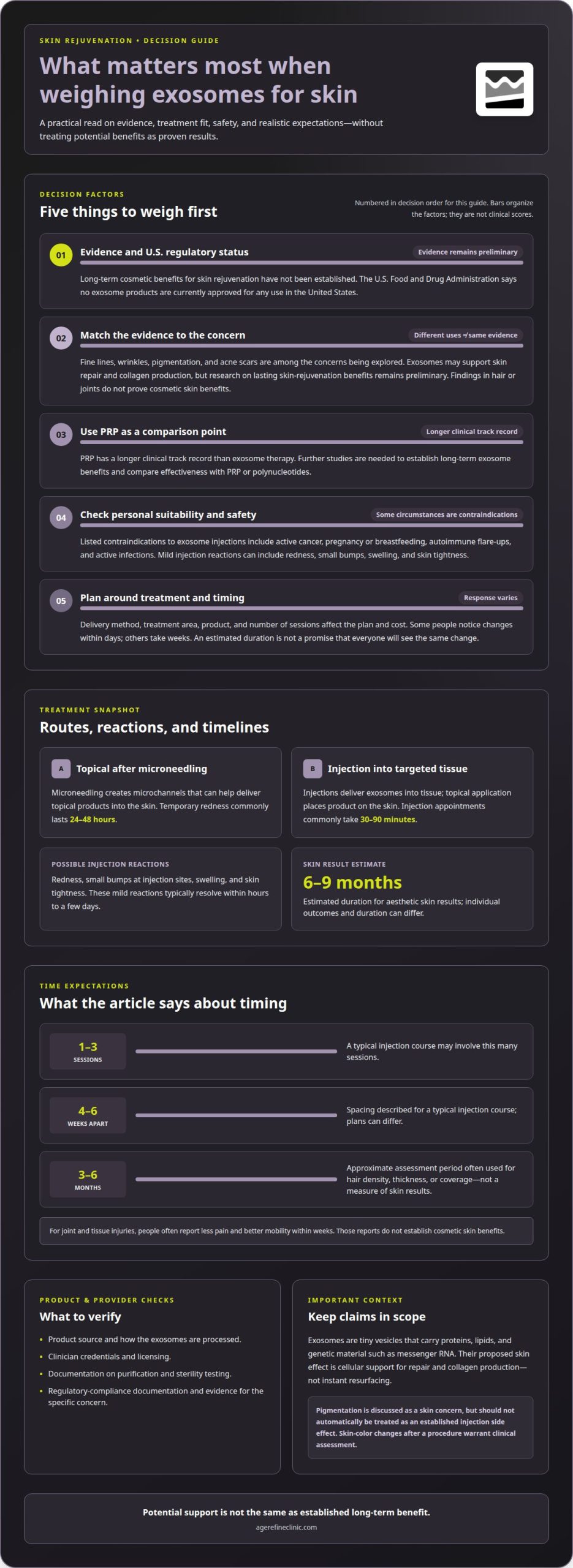
The newest option isn’t always the most established. Whether exosome injections are worth it for skin rejuvenation depends on how you weigh potential benefits against limited evidence: research is still preliminary, and the U.S. Food and Drug Administration says no exosome products are currently approved for any use in the United States.
It makes sense to seek treatments for healthier-looking skin while keeping safety and realistic expectations in view. Exosomes may support skin repair and collagen production, but their long-term benefits for rejuvenation have not been established. PRP, by comparison, has a longer clinical track record.
This guide explains what exosomes are, what treatment involves, and how exosome therapy compares with PRP. You’ll get a clearer picture of potential benefits, the limits of current evidence, and the factors to consider when deciding whether this approach fits your skin goals.
Key Takeaways
- Learn which skin concerns exosome treatments may target and how to interpret the proposed benefits.
- Understand what an exosome treatment can involve and why evidence differs by treatment area.
- See how exosome therapy and PRP differ in their approach to skin rejuvenation.
- Recognize potential side effects and the factors that matter when weighing treatment options.
Can exosomes help with skin rejuvenation and anti-aging?
Exosomes may support skin repair and collagen production, making them a potential option for facial rejuvenation. Evidence for lasting cosmetic benefits remains preliminary, so weigh the potential against what research has established.
How Exosomes May Affect Skin
Exosomes are tiny vesicles released by cells, including stem cells, that carry proteins, lipids, and genetic material such as messenger RNA. These contents can influence how nearby cells communicate. For skin, that signaling may support repair and collagen production, processes relevant to texture and visible signs of aging. The proposed effect is cellular support, not an instant resurfacing of the skin.
Potential Benefits for Skin, Hair, and Joints
In aesthetic care, exosomes may support smoother texture, skin healing, and a more refreshed facial appearance. They may also be applied topically after microneedling, which creates microchannels that can help deliver products into the skin. Exosome therapy is also being explored for hair restoration and tissue or joint concerns. Because these uses have different goals, potential effects in one area do not prove results in another.
Skin Concerns and Rejuvenation Efficacy
Potential skin concerns include fine lines, wrinkles, pigmentation, and acne scars. These goals may appeal to patients seeking support for both skin tone and texture. However, research on skin rejuvenation remains preliminary, and large, long-term clinical trials are needed. Further studies are also needed to establish long-term benefits and compare effectiveness with PRP or polynucleotides, DNA fragments that may support skin repair.
Regulatory status is another consideration in the United States: the U.S. Food and Drug Administration says no exosome products are currently approved for any use. This does not determine whether a treatment will improve an individual’s appearance, but it matters when weighing a developing approach against established expectations. Consider whether the proposed benefit matches the concern being treated and the strength of evidence for that specific use.
What happens in an exosome treatment?
Treatment depends on the area and delivery method. For facial skin, exosomes may be applied topically after microneedling creates microchannels. This pairs the product with a procedure intended to support skin repair. Temporary redness after microneedling with exosomes commonly lasts 24 to 48 hours, so recovery planning matters. Injection appointments commonly take 30 to 90 minutes, though that duration doesn’t describe every topical treatment.
Evidence also varies by treatment area. For skin, research into rejuvenation remains preliminary, and long-term results need further study. Hair-loss treatment research is at an early stage, with limited clinical trials. Hair density, thickness, or coverage is commonly assessed over approximately 3 to 6 months, rather than immediately. For joint and tissue injuries, patients often report less pain and better mobility within weeks, but those outcomes don’t establish cosmetic skin benefits.
Timing varies by response and goal. Some patients notice changes within days, while others take weeks. A typical injection course may involve 1-3 sessions spaced 4-6 weeks apart; treatment plans can differ. Aesthetic skin results are estimated to last around 6-9 months. These timelines help frame expectations, but they don’t mean every patient will see the same change or duration.
In the United States, the cost of exosome treatment depends on the treatment area, delivery method, product, and number of sessions. At AgeRefine Clinic in Irvine, the price depends on the individual case and is provided after a quote request. A quote should reflect the planned treatment, rather than assume skin, hair, and joint procedures cost the same.
For facial texture concerns, microneedling with topical exosomes is one approach; injection treatment is another. Temporary redness and the time needed to assess changes are practical considerations for either option. The treatment’s purpose matters: early evidence on hair loss or reports about joints should not be taken as proof of effectiveness for skin rejuvenation.
What Are Exosome Injections?
Exosome injections deliver tiny extracellular vesicles into targeted tissue. Exosomes measure approximately 30-150 nanometers and carry biological signals between cells. In aesthetic treatments, those signals are intended to support healing and regeneration. The procedure differs from topical application, which places a product on the skin rather than injecting it.
After an injection, mild reactions can include redness, small bumps at injection sites, swelling, and skin tightness. These reactions typically resolve within hours to a few days. Pigmentation changes deserve separate attention: although pigmentation is discussed as a skin concern in relation to exosome therapy, it should not automatically be considered an established injection side effect. Changes in skin color after a procedure warrant clinical assessment.
Suitability also depends on health circumstances. Active cancer, pregnancy or breastfeeding, autoimmune flare-ups, and active infections are listed contraindications to exosome injections. These factors matter because an elective regenerative procedure should take active illness, immune activity, and pregnancy status into account. Long-term systemic health risks have limited supporting data, so the developing evidence base is relevant to informed decision-making.
Patients can assess product and provider safety claims by reviewing the product source, the clinician’s credentials and licensing, and documentation on purification, sterility testing, and regulatory compliance. In the United States, the U.S. Food and Drug Administration says no exosome products are currently approved for any use.
Before considering injections, ask the clinician about the source of the exosomes, how the product is processed and tested, and what evidence supports its use for your specific concern. Discuss personal contraindications, possible reactions such as swelling or redness, and how changes in pigmentation would be assessed. Clear answers help distinguish a defined treatment plan from broad claims about regeneration.
Exosome therapy versus PRP
Exosome therapy and platelet-rich plasma (PRP) use different biological materials and preparation methods. PRP begins with a blood draw, followed by separation of the platelet-rich portion for reinjection. Exosome therapy uses cell-free material described as ready to use. This difference affects the treatment process, but does not establish which option produces better skin rejuvenation.
PRP has a longer clinical track record than exosome therapy and may cost less. Exosomes carry signaling molecules, including proteins, and are intended to influence cellular activity. This proposed mechanism explains interest in exosomes, but does not prove superior visible or lasting results. If you’re asking, “are exosome injections worth it?” the answer depends partly on how much weight you place on emerging mechanisms versus a longer history of clinical use.
Exosomes aren’t stem cells. They’re cell-free vesicles, unlike regenerative therapies that use cells. Polynucleotides offer another comparison: they are DNA fragments discussed for skin repair and regeneration, rather than exosome products. These materials and their proposed actions differ, but those distinctions alone don’t show which approach works best for a particular aesthetic goal.
For a practical comparison, consider the preparation involved, the treatment goal, and the depth of evidence for that use. PRP requires blood collection and processing; exosome therapy avoids the blood-draw step. PRP’s longer clinical track record provides a more established reference, while comparative research is still needed to clarify how exosomes perform against PRP or polynucleotides. Asking “are exosome injections worth it compared with PRP?” is most useful when you frame the decision around your priorities and the evidence for your specific concern.
For a personalized discussion of regenerative options, explore exosome injection care.
AgeRefine Clinic: Exosome Injection
AgeRefine Clinic offers Exosome Injection for people exploring regenerative approaches to skin rejuvenation in Irvine and Orange County. If you’re weighing potential benefits against early evidence and safety considerations, a focused discussion can clarify what the treatment is intended to address and how it relates to your goals.
The right approach depends on the concern you want to treat. Exosome Injection is one option; wrinkle relaxer Xeomin addresses a different aesthetic goal, so it isn’t a substitute for every skin treatment. A conversation about your priorities can help distinguish these approaches and set realistic expectations without assuming one method suits everyone.
If you’d like to discuss whether Exosome Injection aligns with your skin goals, contact AgeRefine Clinic.
Choose a Next Step That Fits Your Skin Goals
Deciding whether exosome injections are worth it starts with defining the change you want to see. A concern about skin texture calls for a different conversation than expression lines or broader skin revitalization. Naming your priority makes the treatment discussion more focused and helps you consider options in context, rather than choosing a procedure based on novelty alone.
AgeRefine Clinic offers Exosome Injection alongside other aesthetic options, including Onda Pro, XERF, and wrinkle relaxer Xeomin. These treatments address different goals, so the next step is a thoughtful discussion about what you hope to change and which approach suits that concern. A considered choice should reflect your preferences and comfort with the evidence.
Contact AgeRefine Clinic to discuss your options and take a considered next step toward care that aligns with your goals.
Frequently Asked Questions
Can exosomes help with hair loss?
Exosome treatments for hair loss are being studied, but clinical trials remain limited and research is at an early stage. The proposed goal is to support hair restoration, yet early evidence cannot establish a reliable outcome for an individual. If you’re discussing this option, focus on the specific type of hair concern and how progress would be evaluated, rather than assuming results seen in skin or joint treatments apply to the scalp.
Where do exosomes come from?
Exosomes are tiny vesicles released by nearly every cell in the body. Cosmetic exosomes may come from plants or healthy donor stem cells, so the source can vary between products. This matters because “exosome” describes the vesicles, not a single standardized ingredient. Understanding the source helps clarify what a product contains and its intended use.
Do exosomes carry risks?
Yes. Reported mild reactions to injections include redness, small bumps, swelling, and skin tightness; long-term systemic risks have limited supporting data. Active cancer, pregnancy or breastfeeding, autoimmune flare-ups, and active infections are listed contraindications. These considerations make medical history relevant to treatment suitability, especially when considering an elective aesthetic procedure.
How effective and safe is exosome therapy?
Research on exosomes for skin rejuvenation remains preliminary, and large, long-term clinical trials are needed to establish lasting benefits. Effectiveness compared with PRP or polynucleotides also requires further study. Safety assessment is complicated by differences in product purification, isolation, storage, scalability, and reproducibility, as standardized manufacturing practices for healthcare exosomes have not been established.
How are exosomes different from stem cells?
Exosomes are cell-free vesicles, while stem cells are cells. Exosomes carry biological signals that may influence communication between cells; they are not stem cells and do not become new tissue. This distinction helps explain how exosome therapy differs from traditional regenerative cell-based approaches. A product’s source and composition still matter, since the term “exosome” alone doesn’t describe every preparation.
Is Exosome Therapy FDA Approved?
No exosome products are currently approved by the U.S. Food and Drug Administration for any use in the United States. This status is important context when weighing treatment claims, including claims about aesthetic benefits. It does not, by itself, establish how an individual will respond; it means you should not assume an exosome product or injection is approved.