


The most significant risk in the pursuit of biological optimization isn’t the molecule itself, but the lack of professional oversight that often follows the hype. While digital forums are filled with anecdotes of transformative vitality, they’re equally crowded with valid concerns regarding the side effects of peptide therapy and the safety of self-administration. You’ve likely felt the tension between wanting to optimize your cellular health and fearing the long-term hormonal consequences of an unregulated product. It’s a delicate balance. You deserve a sanctuary where medical innovation meets high-end, personalized care.
True wellness is built on a foundation of scientific rigor and personal safety. This guide provides an expert-led review of common versus rare reactions, the critical sourcing risks associated with “research chemicals,” and professional strategies to mitigate discomfort. We’ll examine the upcoming July 2026 FDA compounding reviews and establish a clear framework for choosing a clinical provider over DIY options. This ensures your path to restoration is both sophisticated and secure, moving you from a place of anxiety to one of informed confidence.
Key Takeaways
- Understand how peptides function as biological signaling molecules and why their systemic nature can lead to specific, predictable physical responses.
- Identify the most common side effects of peptide therapy, from localized injection site reactions to temporary water retention, and learn how to manage them effectively.
- Recognize the profound safety differences between pharmacy-grade compounds and unregulated “research chemicals” that often contain harmful impurities.
- Master the clinical protocols used to minimize risks, including the importance of proper titration and the strategic use of cycling to maintain cellular sensitivity.
- Discover how professional clinical oversight transforms a complex medical treatment into a refined, safe, and deeply personal journey toward biological optimization.
Understanding Peptides and the Clinical Reality of Side Effects
Vitality is the language of communication within our bodies. At the cellular level, this dialogue is conducted by peptides: short chains of amino acids that serve as biological signaling molecules. They don’t just exist; they instruct. They tell your cells to repair tissue, release hormones, or modulate immune responses. While peptide therapeutics have been used in medicine for decades, the rise of synthetic analogs has allowed us to mirror these natural processes with high precision. These analogs are designed to be more stable than our endogenous peptides, which are those naturally occurring in the body, allowing them to remain active long enough to achieve a meaningful therapeutic effect.
Understanding the clinical reality of side effects of peptide therapy requires looking at how these signals travel. Even when we target a specific goal, such as skin rejuvenation or metabolic efficiency, the peptide enters the systemic circulation. It’s this systemic nature that occasionally leads to side effects. If a peptide “instructs” a cell to retain water or increase a specific hormone, that instruction might be heard by receptors in areas we didn’t intend to target. This isn’t a failure of the molecule, but a byproduct of how biological signaling works across complex systems.
Peptides vs. Traditional Pharmaceuticals
True restoration requires a delicate touch rather than a blunt instrument. Synthetic drugs often act like a shotgun, hitting multiple biological pathways with persistent chemical structures that the body must work hard to eliminate. Peptides are different. Because they are composed of amino acids, the body recognizes them as natural building blocks. Once their signaling mission is complete, they are metabolized into harmless components. This biological familiarity is why side effects are often transient. They don’t linger in the liver or kidneys like complex synthetic compounds. They deliver their message and depart, offering a safety profile that is inherently higher because they work with your biology rather than against it.
The Role of Signaling in Biological Optimization
Precision is the hallmark of modern regenerative medicine. Peptides achieve results by binding to specific cell receptors in a lock-and-key mechanism. However, when doses are poorly calibrated or sourced from unregulated vendors, “off-target” effects can occur. This is where the side effects of peptide therapy usually manifest. If the “key” doesn’t fit perfectly or the concentration is too high, the body’s response can feel exaggerated. Professional clinical oversight ensures that these signals remain precise. It transforms a broad biological nudge into a refined, targeted optimization, ensuring your journey toward longevity is both effective and safe.
Common Side Effects of Peptide Therapy: What to Expect
Optimization is a journey of cellular recalibration. As your body begins to interpret new biological signals, it’s natural to experience an adjustment period while your systems find a new equilibrium. Most common side effects of peptide therapy are mild, transient, and manageable when conducted under clinical supervision. Understanding these responses helps distinguish between a healthy biological shift and a reaction that requires a dosage adjustment. Knowledge replaces anxiety with confidence, allowing you to focus on your long-term restoration goals.
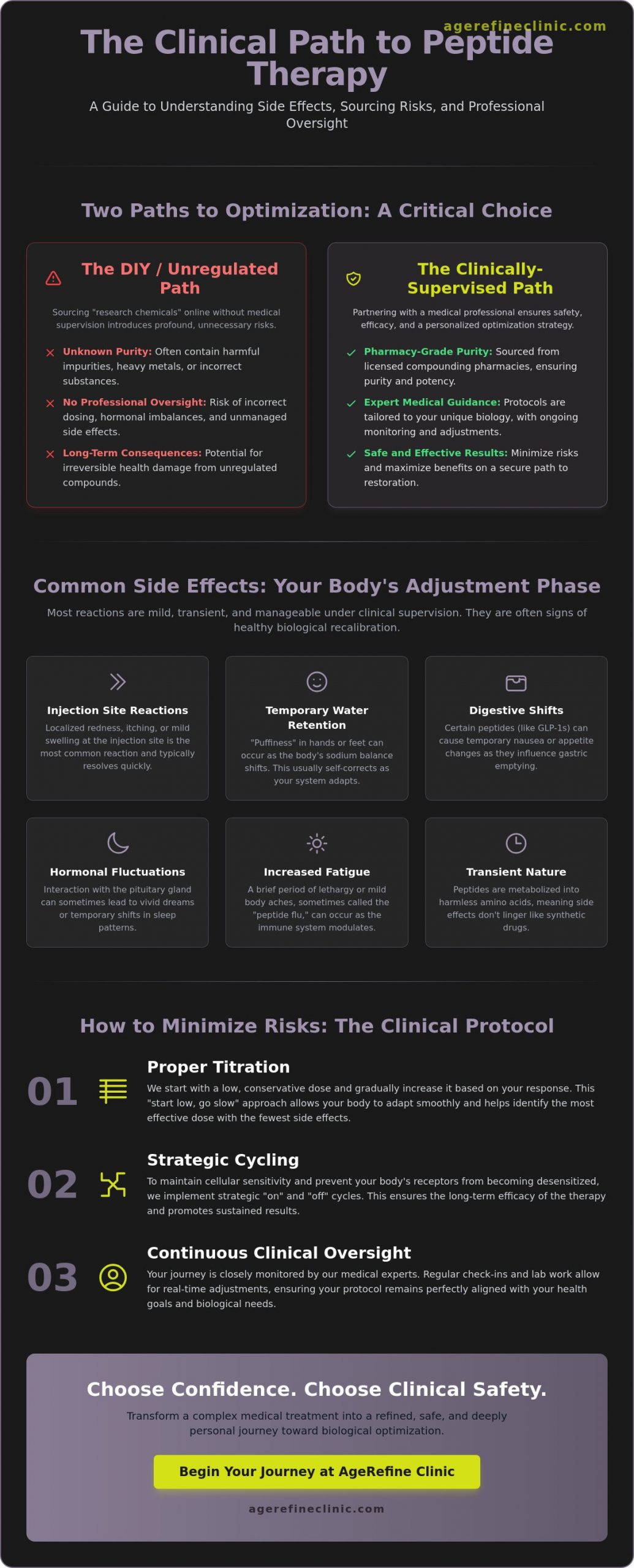
The most frequent experiences are localized rather than systemic. Injection site reactions, such as redness, itching, or mild swelling, occur as the skin responds to the administration process. Beyond the surface, some patients notice temporary water retention or “puffiness” in the extremities. This edema is often a result of the body’s sodium balance shifting in response to growth hormone signaling. It usually resolves as the body adapts. Other common markers of the adjustment phase include:
- Digestive Shifts: GLP-1 analogs may cause temporary nausea or changes in appetite as they influence gastric emptying.
- Hormonal Fluctuations: Secretagogues interact with the pituitary gland, which can occasionally lead to vivid dreams or shifts in sleep depth.
- The “Peptide Flu”: A brief period of lethargy or mild body aches can occur as the immune system and metabolic pathways respond to new regenerative signals.
Side Effects of Healing Peptides (e.g., BPC-157, TB-500)
Regenerative peptides like BPC-157 and TB-500 are renowned for their exceptional safety profiles. Because they mirror the body’s natural healing compounds, adverse reactions are rare. A small number of patients report transient dizziness or slight shifts in blood pressure immediately following administration. These effects are typically short-lived. BPC-157 is particularly well-tolerated, often aiding gut health and tissue repair without the systemic burden associated with traditional anti-inflammatories. Most “side effects” in this category are simply signs of the body’s accelerated repair mechanisms at work.
Side Effects of Growth Hormone Secretagogues (e.g., Ipamorelin, Sermorelin)
Secretagogues work by gently encouraging your own pituitary gland to release growth hormone. This natural approach minimizes risk but can lead to specific sensations. Increased hunger is common, as these peptides can mimic ghrelin, the body’s hunger hormone. Some individuals experience paresthesia, a mild tingling in the hands or feet. While harmless, it’s a signal that your clinical protocol might need refinement. Long-term use requires monitoring of insulin sensitivity, though professional titration at AgeRefine Clinic ensures these pathways remain optimized and healthy.
The Risk of Unregulated Sourcing: Pharmacy-Grade vs. Research Chemicals
Integrity is the bedrock of any regenerative journey. While the digital landscape has made biological optimization more accessible, it’s also birthed a precarious gray market for “research chemicals.” These products are sold with a mandatory “Not for Human Consumption” label, a disclaimer that many enthusiasts dismiss as a mere legal loophole. In reality, this label indicates a total absence of the rigorous safety standards required for clinical administration. Vials sourced from unregulated vendors are frequently plagued by heavy metals, bacterial endotoxins, or incorrect amino acid sequences. When these impurities are introduced into the body, the side effects of peptide therapy can shift from mild, expected adjustments to severe immune reactions or systemic infections.
The distinction between an online vendor and a 503B Compounding Pharmacy is a matter of biological security. Licensed pharmacies operate under strict federal oversight, ensuring that every batch undergoes comprehensive testing for purity and potency. This pharmaceutical precision ensures that the molecule you receive is exactly what your body expects. Choosing a regulated source eliminates the variables of contamination that often lead to the most distressing side effects of peptide therapy, replacing uncertainty with the peace of mind that comes from clinical-grade restoration.
The Danger of the DIY “Biohacking” Approach
Self-treating in a home environment introduces risks that no amount of online research can mitigate. Sterility is the primary concern; home-mixed vials are easily contaminated during the reconstitution process. Without a sterile laboratory environment, even a high-quality powder can become a breeding ground for bacteria once liquid is added. Furthermore, incorrect reconstitution can lead to degraded or ineffective solutions that irritate the injection site. Perhaps most importantly, the DIY approach lacks a “rescue plan.” If an adverse reaction occurs, there is no clinician to guide you through a dosage adjustment or a protocol shift, leaving you to navigate a medical concern alone.
Why Clinical Oversight is Your Best Safety Protocol
Professional guidance transforms peptide therapy from a trend into a sophisticated medical protocol. Before a single injection is administered, comprehensive blood work is essential to determine if you’re an appropriate candidate. A clinician monitors markers of inflammation and hormonal balance, ensuring that the therapy supports your internal environment rather than disrupting it. At AgeRefine Clinic, we prioritize transparency by utilizing pharmaceutical-grade certificates of analysis (COA). These documents verify the sequence and purity of every peptide, ensuring your path to longevity is guided by scientific rigor and an unwavering commitment to your long-term health.
How to Minimize Risks: Protocols for Safe Peptide Administration
Safety is a deliberate practice, not an afterthought. In the pursuit of biological optimization, the methodology of administration is just as critical as the molecule itself. By adhering to rigorous clinical protocols, we can significantly reduce the potential for side effects of peptide therapy while maximizing regenerative outcomes. This disciplined approach ensures that your body remains responsive to the delicate signals these molecules provide, fostering a state of long-term vitality rather than temporary stimulation. True restoration is achieved when we work in harmony with your natural systems.
One of the most effective strategies for long-term success is titration. Starting with a low dose and gradually increasing it allows your cellular receptors to adjust without becoming overwhelmed. This “low and slow” method is particularly important for metabolic and growth hormone peptides, where rapid changes can trigger water retention or lethargy. Additionally, cycling is essential. The body is designed for rhythm, not constant saturation. By incorporating planned breaks into your protocol, you prevent the desensitization of cell receptors and maintain the therapy’s efficacy over time. Practical lifestyle factors also contribute to a smooth experience:
- Hydration: Adequate water intake supports the metabolic breakdown of peptides and reduces the risk of edema.
- Sleep Quality: Peptides like secretagogues rely on the body’s natural circadian rhythms to maximize growth hormone release.
- Injection Technique: Utilizing proper subcutaneous techniques ensures steady absorption and minimizes localized tissue irritation.
Dosing Precision and the “Minimum Effective Dose”
Biological signaling is a matter of nuance. In the world of peptide therapy, higher doses do not equate to better results; in fact, they often lead to receptor burnout. Personalized dosing ensures that your unique biochemistry is respected, allowing for a more refined experience. The Minimum Effective Dose is the threshold where benefits manifest without triggering adverse signaling. By finding this “sweet spot,” we ensure that your journey remains both effective and comfortable, avoiding the systemic stress of over-stimulation.
Monitoring and Adjusting Your Protocol
A successful protocol is a living document. Check-ins at the 4-week and 8-week marks are essential to evaluate your progress and screen for any lingering side effects of peptide therapy. It is vital to distinguish between a mild adjustment period, like temporary redness at the injection site, and a true allergic reaction that requires an immediate pause. If a specific molecule causes persistent sensitivity, we can pivot to alternative regenerative solutions to ensure your progress never stalls. This constant refinement is what separates professional clinical care from the risks of self-treatment.
Your safety is our priority. To begin a journey guided by clinical precision and empathetic care, schedule your consultation at AgeRefine Clinic today.
Peptide Therapy at AgeRefine Clinic: Safety-First Optimization in Irvine
True vitality is a collaborative masterpiece, requiring both a discerning eye and a scientifically grounded hand. At AgeRefine Clinic, we’ve created a medical-boutique sanctuary in Irvine where regenerative wellness is treated with the sophistication it deserves. Our philosophy centers on the belief that biological optimization should never come at the cost of safety. By merging elite clinical standards with a deeply personal touch, we provide a space where you can explore the transformative potential of cellular signaling with absolute peace of mind.
The foundation of our practice is the expertise of Helen Liu, NP. Her approach is defined by a rare blend of clinical rigor and aesthetic precision, ensuring that every protocol is as safe as it is effective. Helen understands that navigating the side effects of peptide therapy requires more than just a prescription; it requires a dedicated partner who monitors your biological markers and adjusts your path in real-time. We prioritize pharmaceutical-grade sourcing exclusively, working only with accredited compounding pharmacies to ensure that every molecule meets the highest standards of purity and potency. This commitment eliminates the variables of contamination that often plague the unregulated market.
Personalized Wellness Plans in Orange County
Restoration is rarely a singular event. It’s a multi-faceted process that often involves integrating various regenerative modalities. Within our Irvine sanctuary, we frequently combine peptide therapy with targeted IV Therapy or advanced Laser Skin Rejuvenation to achieve holistic, natural-looking results. This comprehensive approach ensures that your external radiance matches your internal cellular health. We invite you to join us for a thorough consultation where we can discuss your specific health goals, review your diagnostic blood work, and address any safety concerns you may have about starting a regenerative protocol.
The AgeRefine Difference: Science, Integrity, and Results
Our commitment to your longevity is rooted in science and sustained by integrity. We believe in a “less is more” philosophy, utilizing the minimum effective dose to trigger positive change without overwhelming your system. This careful titration is the key to avoiding the common side effects of peptide therapy and ensuring a smooth, empowering transition to a more vibrant version of yourself. It’s time to move past the risks of the DIY biohacking world and embrace a partnership built on professional excellence and long-term well-being.
Your journey toward biological optimization deserves the highest level of clinical oversight. Schedule your Peptide Therapy consultation in Irvine today and take the first step toward a safer, more refined path to health.
Your Path to Refined Biological Optimization
True vitality is a partnership between scientific innovation and clinical safety. You’ve learned that while the side effects of peptide therapy are often manageable, they’re heavily influenced by the quality of the source and the precision of the protocol. Moving beyond the uncertainty of unregulated “research chemicals” is the first step toward genuine restoration. By prioritizing pharmaceutical-grade 503B compounded peptides and rigorous lab monitoring, you ensure your body receives only the most precise biological signals.
At AgeRefine Clinic, Helen Liu, NP, leads a journey of cellular recalibration tailored to your unique biochemistry. Our personalized dosing protocols are designed to foster long-term health without the risks of a DIY approach. You deserve a sanctuary where medical expertise meets empathetic care, ensuring every step of your journey is both sophisticated and secure. It’s time to replace anxiety with informed confidence.
Book Your Personalized Peptide Consultation at AgeRefine Clinic Irvine
Your future self is waiting for a more vibrant, optimized version of you. We’re here to guide you safely toward that horizon.
Frequently Asked Questions
Is peptide therapy safe for long-term use?
Peptide therapy is safe for extended periods when administered through strategic cycling protocols. Constant saturation can lead to receptor desensitization, which is why we recommend planned breaks to maintain your body’s natural sensitivity. Clinical oversight ensures your long-term wellness remains the priority, moving you toward restoration without the risk of biological burnout.
Can peptides cause cancer or tumor growth?
Current research does not indicate that peptides cause cancer. However, growth-promoting peptides could potentially influence the growth rate of existing, undiagnosed tumors. This biological reality is why we insist on comprehensive screening and blood work before initiating any regenerative protocol. It’s a matter of ensuring your internal environment is prepared for optimization.
What should I do if I experience an itchy bump at the injection site?
An itchy bump is the most frequent of the side effects of peptide therapy and typically represents a minor localized histamine response. You should apply a cool compress and avoid disturbing the area. While these reactions usually resolve within a few hours, you should notify your clinician if the redness expands or if you experience systemic symptoms.
Are peptide side effects permanent?
Side effects are almost universally transient and resolve once the peptide is metabolized. Because these molecules are short chains of amino acids, your body breaks them down quickly into harmless components. Permanent changes are not a characteristic of these signaling molecules when they are used according to professional clinical guidelines.
Do peptides interact with other medications or IV therapies?
Peptides can interact with certain medications, particularly those managing blood glucose or thyroid function. They are often safely integrated with IV Therapy to provide a multi-faceted approach to cellular health. Your clinician will review your current medications to ensure every element of your wellness plan works in perfect harmony.
How soon will I notice side effects if they occur?
You will typically notice localized reactions at the injection site within minutes of administration. Systemic adjustments, such as shifts in appetite or mild water retention, generally appear within the first 7 to 14 days. This window allows your body to calibrate its response to the new biological instructions properly.
Is peptide therapy FDA approved?
Some peptides are FDA approved for specific conditions, while many others are utilized off-label within a professional clinical framework. As of May 2026, several popular compounds are undergoing a formal FDA review for compounding eligibility. We exclusively use pharmaceutical-grade substances to ensure the highest level of safety and potency for our patients.
Can I take peptides if I have an autoimmune condition?
Patients with autoimmune conditions can often benefit from peptide therapy, but it requires a highly personalized approach. Certain peptides may support immune modulation and tissue repair, while others could potentially trigger unwanted activity. A thorough consultation is essential to determine which signaling molecules will best support your unique health transition.
Leave a Reply